


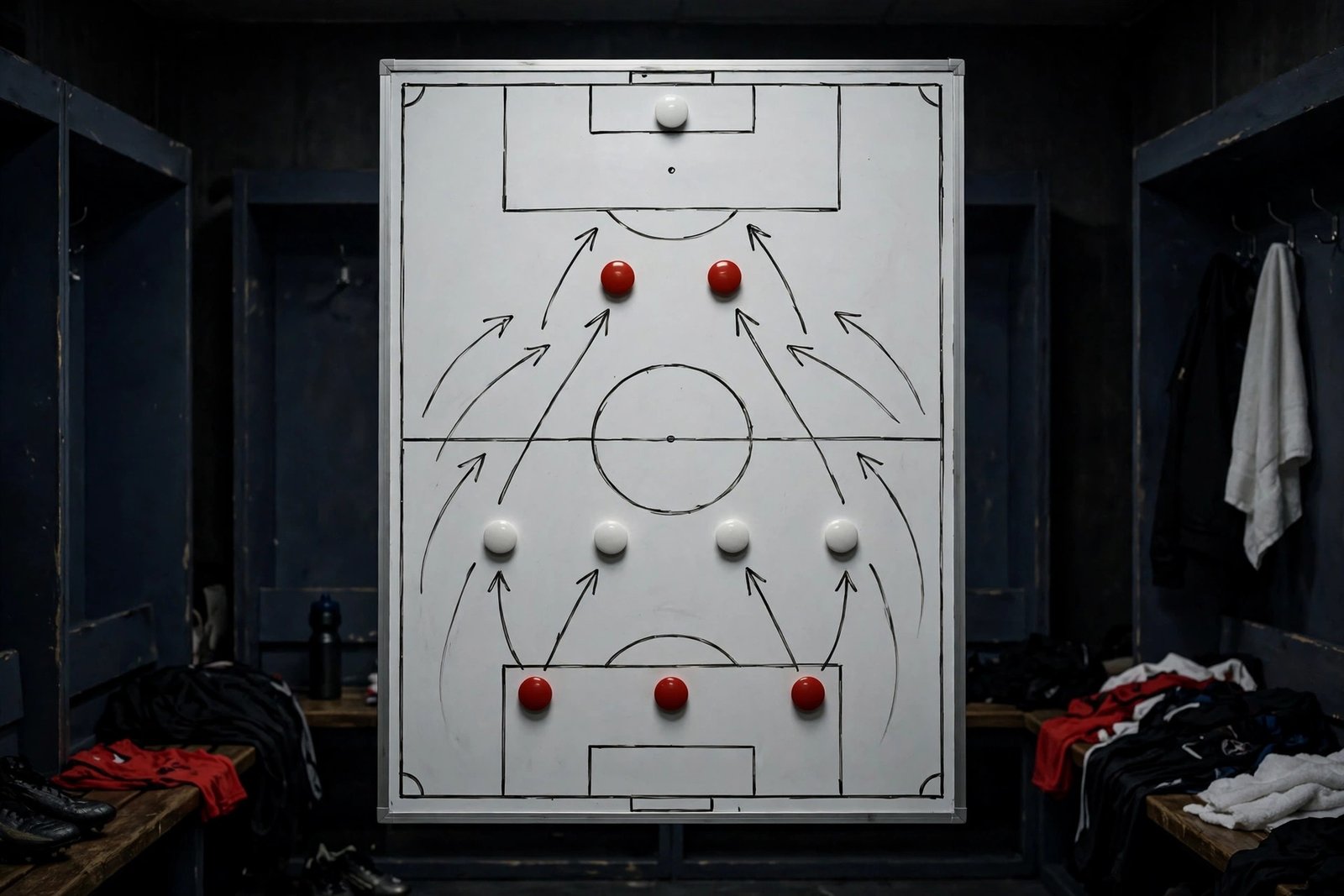
There is a sound Old Trafford used to make when Manchester United won a corner: polite applause, and then a kind of settling-in, because everyone in the ground understood the corner was really just a brief pause before the goalkeeper caught the ball. Watch this team now and the sound has changed. There is a lean forward, a genuine stir — because under Michael Carrick, dead balls have become one of the few reliably dangerous things about this side. For a team learning a demanding new system, sitting uncomfortably low in the table, that is not a cosmetic improvement. It is a lifeline, and increasingly, a weapon.
The Delivery: Fernandes and the Value of Repetition
Every set-piece renaissance starts with the taker. Bruno Fernandes’ delivery has been good for years, but this season it has become consistent in a way it previously was not — flatter, faster, aimed into the corridor between the six-yard line and the penalty spot rather than floated hopefully into traffic. The second ball matters as much: Youri Tielemans offers a genuine alternative from the other side and from deeper free-kicks, which means opponents cannot simply set their defence for one man’s outswinger. It sounds like a small thing. It is the whole thing. A predictable corner is a clearance waiting to happen; two elite takers, hitting the same two or three rehearsed zones, is a system. Opposition analysts can prepare for a routine — what they cannot prepare for is variety within it, the near-post flick one week and the deep pull-back the next.
The Machinery: Blockers, Screens and the Front-Post Flick
Delivery is only half the routine. What has visibly changed under Carrick — whose staff have clearly made dead balls a training-ground priority, as anyone who has read our full tactical breakdown of Carrick’s system will recognise as part of a wider pattern — is the choreography in front of the ball. United now attack corners in waves: a blocker stepping into the path of the zonal marker, a front-post runner dragging the near-post defender with him, and the main aerial threats starting deep and arriving late rather than wrestling statically with their markers from the first whistle. It is borrowed from the league’s best set-piece sides and it is entirely deliberate. Harry Maguire, starting position after starting position, now gets a running start at the ball instead of a standing wrestle — and a running Maguire, attacking a cross, remains one of the most unfair sights in English football.
The Personnel: A Team Built Bigger Than It Looks
The 3-4-2-1 is sometimes described as a small team’s shape, all 10s and technicians. Look at who actually attacks the ball, though, and United are quietly enormous where it counts: Maguire and Leny Yoro from the back three, Benjamin Sesko’s height when fit, and a crowd of willing screeners in between. Lammens’ command of his own box has improved the other end of the equation too — a goalkeeper who claims crosses changes what a defence dares to do — and United’s defensive set-piece work, long one of the problems Carrick had to fix, has tightened noticeably: fewer free headers, clearer zones, a designated blocker on the opposition’s best jumper.
The Other End: Defending the Box
A set-piece threat is really two weapons, and the defensive half of it deserves its share of the credit. For years, United’s softest goals arrived from their own corners’ mirror image: free headers, lost second balls, a goalkeeper rooted to his line. The tightening this season has been structural rather than miraculous — a settled zonal line, a designated attacker of the ball at the near post, and Lammens growing in authority behind them — and it changes match dynamics in ways the highlights never show. A team that trusts its defensive set pieces can commit bodies forward at the other end; a team that does not defends every corner like a siege and attacks its own with one eye on the counter. United have lived both versions. The current one travels better, suffers less, and — whisper it — looks increasingly like the set-piece profile of a serious side rather than a soft one.
Why It Matters Now
None of this is decoration. United’s open-play attack is still a work in progress — the 10s can be crowded out, the striker isolated, the wing-backs pinned — and in a season of fine margins, goals have to come from somewhere that does not depend on everything clicking. Set pieces are the great leveller: they travel, they work at Anfield and the Etihad as well as at home, and they turn single moments into points. Sunday’s visitors make the point perfectly — our Aston Villa preview notes a side drilled to the last detail at dead balls under Unai Emery — and if United are to beat the form team in the country, matching them corner for corner may matter as much as anything that happens in open play. Carrick’s United are being built on an idea. Increasingly, they are being kept alive by the oldest idea in football: put it in the mixer, and mean it.
