


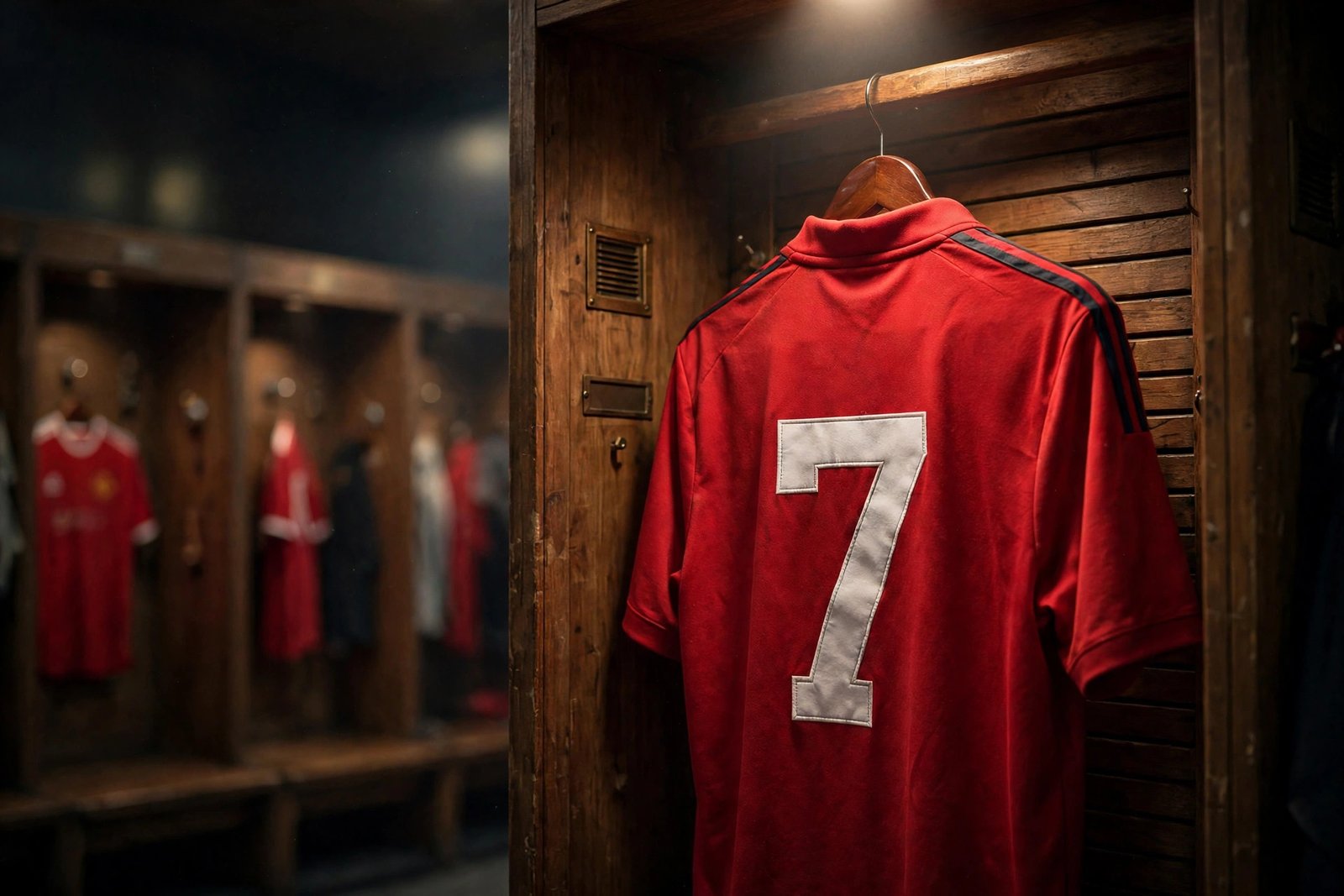
Most squad numbers are admin. At Manchester United, one of them is an inheritance — closer to a crown than a shirt. The No.7 has been worn by the club’s most beloved mavericks for sixty years, and every player who pulls it on knows the deal: you are not just picking a number, you are auditioning for a place in a story that starts with a Belfast teenager and runs through the greatest names the club has ever had. Two of its wearers walk straight into our all-time Premier League XI. This is how a shirt became sacred.
Best and Robson: The Shirt Finds Its Meaning
Squad numbers were not fixed in George Best’s day — players wore the number of their position — but it was in the No.7 that Best produced his defining performances, dribbling through the mud of the sixties with a genius that made him the first footballer-celebrity. When Bryan Robson took the shirt in the eighties, he gave it a second meaning: Captain Marvel, the midfielder who carried mediocre United teams on his back for a decade, all blood, thunder and late runs into the box. Best made the 7 magical. Robson made it heroic. Between them, they made it the number every United-supporting kid in the world wanted on their back.
Cantona and Beckham: The Premier League Icons
Eric Cantona wore the 7 like a tailored suit. Collar up, chest out, he turned the number into a logo for the Ferguson revolution — the artist-king whose every touch felt staged for the cameras. When he retired in 1997, the shirt passed to David Beckham, and a different kind of fame attached itself to it: the free-kicks, the halfway-line audacity, the right foot that delivered the corners of the Treble season. Beckham made the No.7 a global brand; shirts with his name outsold entire clubs. By the time he left for Madrid in 2003, the question in the Old Trafford dressing room was simple and terrifying: who could possibly wear it next?
Ronaldo: The Boy Who Filled It
The answer was an 18-year-old from Madeira who had tormented United in a pre-season friendly — and who, by his own later admission, would have happily taken a quieter number. Ferguson insisted on the 7, and Cristiano Ronaldo grew into it in public: the stepovers, the knuckleball free-kicks, the 42-goal season, the Ballon d’Or, Moscow in the rain. Ronaldo is the last undisputed king of the shirt, the standard every successor has been measured against — and the reason the shirt became, for a while, too heavy to wear. Three league titles, a Champions League and a Ballon d’Or in six seasons set a bar so high that simply being a good player in the No.7 came to look, unfairly, like failure.
The Heavy Years
What followed became known, half-jokingly, as the curse. Michael Owen, a fine player in decline, wore it without ever feeling like a United No.7. Antonio Valencia took it, struggled, and famously handed it back to reclaim his old No.25 — the most honest review the shirt has ever received. Angel Di Maria arrived as one of United’s record signings and was gone within a year; Memphis Depay flickered and faded; Alexis Sanchez’s piano-playing unveiling promised a symphony and delivered a season and a half of wrong notes. Edinson Cavani restored some dignity — a proper centre-forward’s appetite in a veteran’s body — and when Ronaldo returned in 2021, Cavani graciously handed the shirt back and the story came full circle, briefly and bittersweetly. Since Ronaldo’s second departure, the number has rested most recently with Mason Mount, a fine player still writing his chapter. The lesson of the heavy years is not that the shirt is cursed. It is that the shirt is a promise, and Old Trafford — which has staged the greatest moments in Old Trafford’s history with a 7 on the pitch — can always tell when the promise is being kept.
Why It Still Matters
Part of the shirt’s power is cultural arithmetic: the No.7 is the number United sell, gift and dream in. For supporters of a certain age it is inseparable from the Class of ’92 generation that wore the club’s identity on the pitch — Beckham’s 7 was the poster on a million bedroom walls, the shirt in a million five-a-side games. That is why each new wearer is not judged against last season’s occupant but against a composite ghost: Best’s balance, Robson’s bravery, Cantona’s arrogance, Beckham’s delivery, Ronaldo’s relentlessness. No other shirt in English football asks so much, which is precisely why the rare player who satisfies the question becomes more than a footballer at this club. He becomes folklore.
In an era of personal brands and numbers chosen for marketing, United’s No.7 remains stubbornly romantic: a shirt that has to be earned in public, under comparison with ghosts. One day a player will take it and make a generation of children argue that he belongs beside Best, Cantona and Ronaldo. Until then, the 7 hangs in the dressing room like an exam question. That is exactly how it should be.
