


Every dynasty has a beginning, and Manchester United’s Premier League dynasty begins with a phone call about a left-back. In November 1992, Leeds United enquired about Denis Irwin; Alex Ferguson, who had just watched his side’s title challenge begin to leak goals and confidence, countered by asking about Eric Cantona. Within days, the Frenchman was a United player for a fee of around £1.2m — a sum that now looks like a printing error. United had waited 26 years for a league championship. With Cantona, they waited six more months. It is telling that in our all-time Premier League XI, picked from more than three decades of stars, he walks into the team through the middle without argument.
The Catalyst
What Cantona brought was not simply talent, though the talent was immense — the technique, the vision, the finishing with either foot, the chest-out certainty that the ball belonged to him. He brought standards. He stayed behind after training to practise free-kicks until the young players — Beckham, Scholes, the Nevilles — understood that genius was a habit, not a gift. And he brought belief to a club that had developed a talent for finishing second. United won the first Premier League title in 1993, then the Double in 1994, with Cantona as the top scorer, the team’s gravitational centre, and the PFA Players’ Player of the Year. The collar went up, the chest came out, and Old Trafford had its King.
Selhurst Park and the Seagulls
Then, the other side of the legend. In January 1995, sent off at Crystal Palace, Cantona launched himself into the Selhurst Park crowd with a kung-fu kick at a supporter who had been abusing him. The fallout consumed English football: a lengthy ban from the FA, community service, and a press conference that produced the most famous sentence ever uttered by a footballer — “When the seagulls follow the trawler, it is because they think sardines will be thrown into the sea.” United, without him, lost the title on the final day and the FA Cup final a week later. The club stood by him. It remains the defining gamble of Ferguson’s reign: the manager bet that the genius was worth the chaos, and history has never stopped proving him right.
The Return of the King
Cantona came back in October 1995 to a side being written off, its senior players sold, its team sheet full of kids — “you can’t win anything with kids,” as one famous pundit put it. What followed was the purest Cantona season of all: a procession of 1-0 wins in the spring run-in, Cantona scoring the only goal in game after game, Newcastle’s twelve-point lead dissolving under the pressure. Then, at Wembley, the FA Cup final against Liverpool, four minutes from extra time, a volley through a crowd of bodies — Cantona, of course — to complete the Double. If one season explains why older United fans speak of him the way they do, it is that one: the King returned from exile and personally reclaimed the crown. Ferguson later called those months the finest leadership he ever saw from a player — a one-man title race, conducted in public, under the heaviest scrutiny English football could apply.
The Chip Against Sunderland
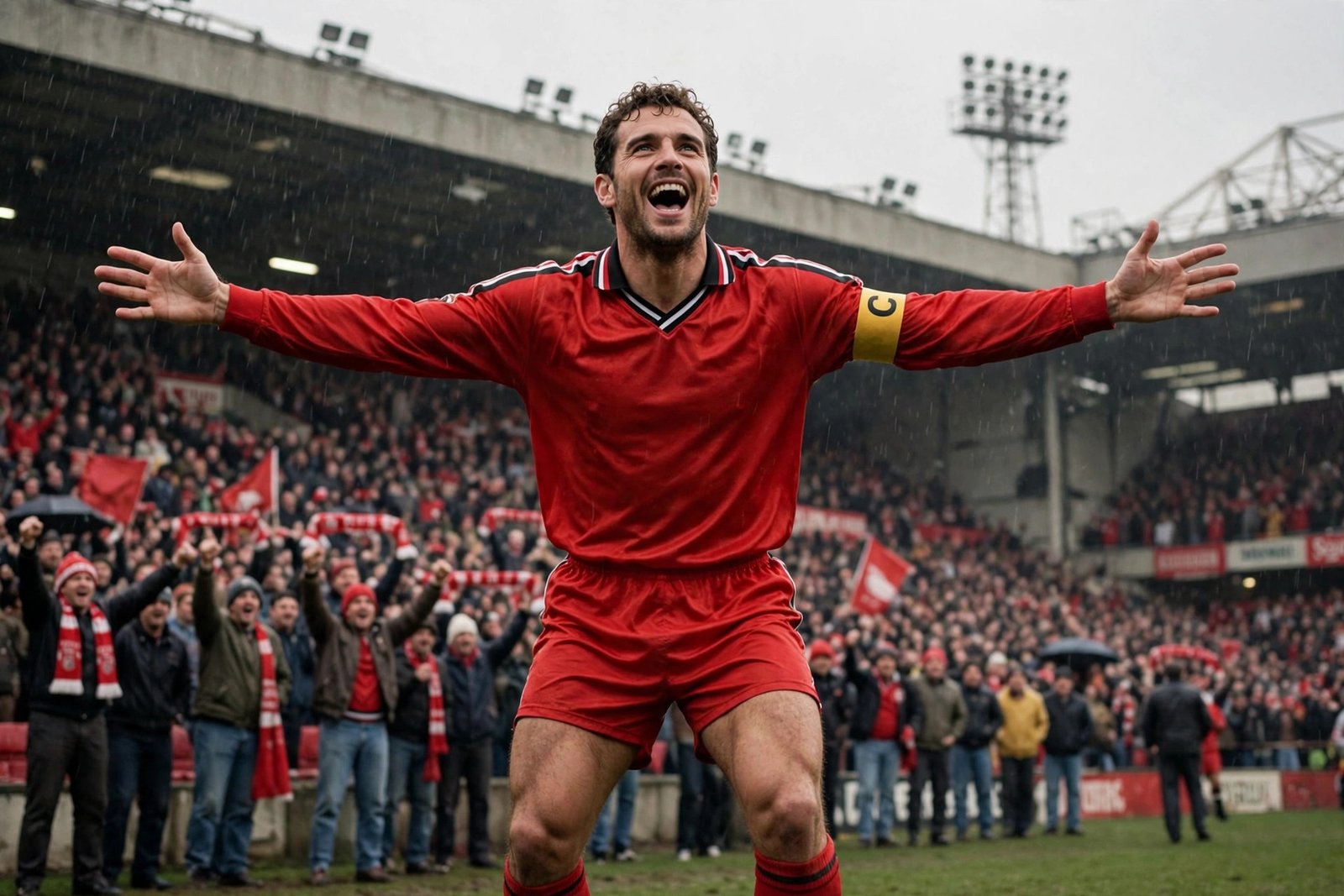
If the legend needs one image, it is December 1996, Sunderland at Old Trafford, the game already won. Cantona received the ball, turned, and — with the calm of a man shelling a pea — chipped the goalkeeper from the edge of the area, the ball kissing the post on its way in. Then he did the thing that made it immortal: he barely celebrated. He turned slowly, chest out, arms slightly raised, rotating like a lighthouse, as if to say: of course. That single moment contains the whole Cantona phenomenon — audacity, technique, theatre, contempt for the ordinary. Modern players rehearse celebrations for social media. Cantona invented one on the spot, out of pure self-belief, and it is still the most replayed goal celebration in the club’s history.
The Exit and the Legacy
In May 1997, at 30 years old, a week after lifting his fourth league title in five seasons, Cantona retired. No farewell tour, no decline, no transfer saga — he simply walked away near his peak, and United have been looking for his like ever since. The raw numbers — more than 180 appearances, more than 80 goals — describe a very good player. They do not describe what he actually was: the man who taught a generation of United players how to carry themselves, whose presence runs through the greatest moments in Old Trafford’s history, and who remains the standard against which every flair player at the club is measured. Players since have won more medals — the full list of how many trophies United have won grew enormously after him. None of it happens on schedule without him. Le King is dead? Not at Old Trafford. Le King lives forever.
