


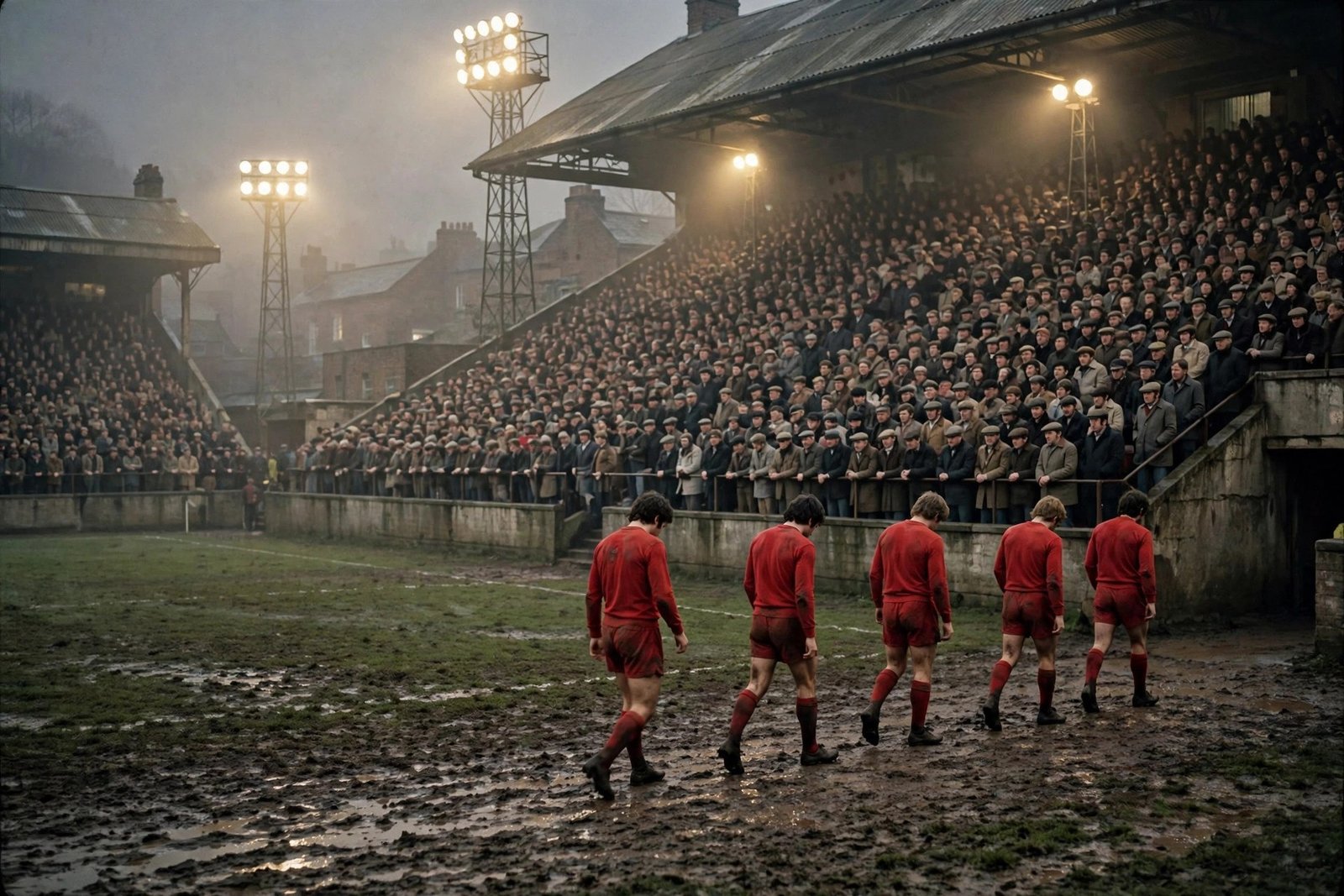
The short answer is yes. Manchester United — England’s most successful league club, with 20 top-flight titles — have been relegated five times: in 1894, 1922, 1931, 1937 and 1974. The question trends every time United have a miserable autumn, and it is being asked again this season, so here is the honest history. United have never been relegated from the Premier League, and have been ever-present in the top flight since 1975. But the five drops that came before are some of the most extraordinary stories in the club’s history — including one sealed by Liverpool, and one “caused” by the most famous backheel in football, which did not actually cause anything at all.
1. 1894 — Sent Down by Liverpool
The first relegation belongs to the club’s original identity. Newton Heath, the railway workers’ team that became Manchester United, finished bottom of the First Division in 1893-94 with just 14 points. In those days there was no automatic relegation: the bottom club faced the Second Division champions in a one-off “test match”, a play-off in all but name. The opponents, at Ewood Park on 28 April 1894, were a young club called Liverpool, who had just won the Second Division without losing a game. Liverpool won 2-0, took the top-flight place, and sent Newton Heath down. It was the first-ever meeting between the two clubs — English football’s greatest rivalry began with a relegation. The Heathens did not return to the top division until 1906, by which time they had a new name: Manchester United.
2. 1922 — The End of an Era
United’s second drop came at the end of 1921-22, when an ageing side finished bottom of the First Division, 22nd, with 28 points. This was a club drifting after the First World War: the great pre-war team had broken up, and winger Billy Meredith — one of the first superstars of English football — had left for Manchester City the previous summer. United spent three seasons in the Second Division before coming back up in 1925, but the return solved nothing. Through the late 1920s they slid steadily backwards — 15th, 18th, 12th, 17th — a famous name living on reputation while the team underneath it rotted. What came next was worse than anyone imagined.
3. 1931 — The Worst Season in the Club’s History
The 1930-31 season remains, by almost any measure, the worst Manchester United have ever played. They lost their first 12 league matches — still the longest losing start to a season by any club in English league history — and the rot never stopped: seven wins all season, 22 points, 115 goals conceded, and bottom place by a distance. Manager Herbert Bamlett was sacked with six games left. Crowds collapsed with the country in the Great Depression; the final match of the season drew fewer than 4,000 people to Old Trafford. Relegation was almost the least of it — by December 1931 the club could not pay its players and stood on the edge of bankruptcy, rescued only when businessman James W. Gibson took over. Gibson’s money saved Manchester United’s existence, not just its status. The five seasons that followed in the Second Division nearly brought a further humiliation: in 1934, United avoided dropping into the Third Division for the only time in their history by beating Millwall on the final day — sending Millwall down instead.
4. 1937 — The Yo-Yo Years
United finally climbed back as Second Division champions in 1936 — and went straight back down. The 1936-37 side finished 21st with 32 points, relegated a year after promotion, the club’s fourth drop and its second in six years. This was the reality of pre-war United: too good for the second tier, too weak and too poor for the first. They bounced back immediately again, finishing second in the Second Division in 1937-38, and this time they stayed — 14th in the last season before the Second World War stopped football. When the league resumed in 1946, Matt Busby was in charge, and everything about the club changed. It is no coincidence that the story of how United rebuilt from the Munich tragedy a generation later began with the stability Busby created in these post-war years: the yo-yo era was over, permanently.
5. 1974 — The Backheel That Didn’t Do It
The most recent relegation is the most famous, and the most misunderstood. Six years after winning the European Cup, a United side in chaos since Busby’s retirement finished 21st in 1973-74. On 27 April 1974, United faced Manchester City at Old Trafford knowing survival was nearly impossible. With nine minutes left, former United hero Denis Law — now playing for City — backheeled the ball past Alex Stepney for the only goal. Law, believing he had relegated his old club, refused to celebrate, was substituted immediately, and never played league football again. Pitch invasions forced the match to be abandoned, though the result stood. Here is the part the myth leaves out: Law’s goal changed nothing. Birmingham City beat Norwich and West Ham drew with Liverpool that day, which meant United would have been relegated even if they had won their last two games. United went down because of a season, not a backheel. And the response was pure United: Tommy Docherty’s young Second Division side tore through 1974-75, won the division, and came straight back — the last time the club has played outside the top flight.
So, Could It Ever Happen Again?
The numbers say how distant those days are. United have spent 22 seasons outside the top division in their entire history, have never played below the second tier, and since that 1975 promotion they have been in the top flight for over fifty consecutive years — one of the six ever-present clubs of the Premier League era. Relegation talk will keep surfacing whenever the autumn goes badly, and United’s toughest remaining fixtures will keep fuelling it, but the historical pattern cuts both ways: every single time this club has gone down, it has come back stronger — champions inside a generation after 1894, Busby’s empire after 1937, and the Docherty revival and everything that followed after 1974. The five drops are not a warning. They are the foundation myth of a club that has made a habit of rising.
