


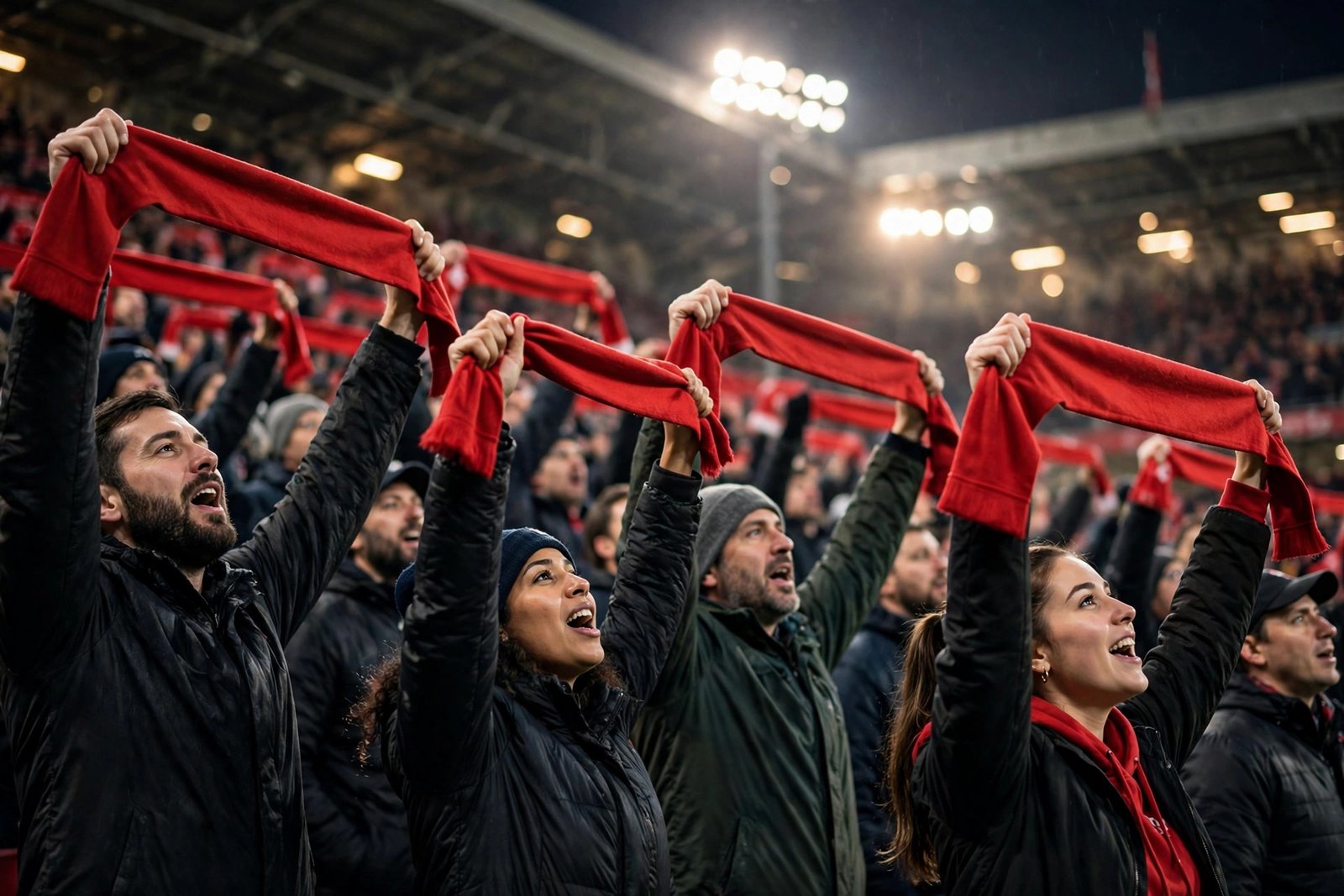
Every club has chants; Manchester United has a songbook. Sung by the Stretford End, carried by the loudest away end in English football, and known by supporters who have never set foot in Manchester, the best Man Utd chants are a history of the club set to borrowed tunes — a Civil War hymn, a John Denver ballad, a Joy Division classic and a Doris Day standard all wearing red. Here are the essential ones: what they are, where they came from, and what they mean.
Glory, Glory Man United
The anthem. “Glory, glory Man United, as the Reds go marching on” is sung to the tune of the Battle Hymn of the Republic, and in its recorded form it was written by Frank Renshaw — a former member of Herman’s Hermits — for the 1983 FA Cup final, with the team themselves singing on the record. The verses are a compressed club history: “Just like the Busby Babes in days gone by, we’ll keep the red flags flying high.” It is the song that swells at kick-off and at cup finals alike, the one opposition fans hear in their sleep, and its shorthand — GGMU — has become the global fanbase’s greeting, hashtag and tattoo. If United supporters ever had to keep only one song, this is the one.
Take Me Home, United Road
The sentimental favourite, and the one most likely to be sung by strangers in airport bars on European trips. It borrows John Denver’s “Take Me Home, Country Roads” wholesale and changes the geography: “Take me home, United Road, to the place I belong.” Where Glory Glory is a march, United Road is a love letter — to the ground, to Manchester, to the idea of home itself. For a fanbase scattered across every time zone, most of whom will watch more matches on screens than they will ever see in person, the lyric lands like a promise: wherever you are, the road leads back to one place. It is best heard in the closing minutes of a big away win, sung slowly, scarves up — the soundtrack of the away end, whose logistics our guide to buying away tickets exists to serve.
We’ll Never Die: The Red Flag and Munich
The most important chant in the songbook, and the one newcomers should learn first. Sung to the tune of “The Red Flag”, its heart is a memorial: “United’s flag is deepest red — it shrouded all our Munich dead.” Written in the shadow of the 1958 disaster, it turns grief into a vow: “We’ll keep the red flag flying high, ‘cos Man United will never die.” It is sung at the worst moments — losing, struggling, relegated in spirit if never in fact — because that is what it is for. Where other clubs’ anthems celebrate winning, this one promises survival, and it connects directly to the history told in our piece on the Busby Babes and Munich. When the Stretford End sings it with a goal needed and the season wobbling, it is not entertainment. It is the club talking to itself.
Que Sera, Sera and the Cup Songs
Cup runs have their own repertoire. “Que sera, sera — whatever will be, will be — we’re going to Wembley” takes Doris Day’s standard and turns it into the sound of a semi-final won, a coach trip booked, a final to dream about. Alongside it sit the defiant standards: “We are the pride of all Europe”, “We’ll do what we want” — a cheeky relic of the years when United really could — and the rolling “U-N-I-T-E-D” that builds from the away end like weather arriving. These are the songs of momentum, dusted off every time a team starts to look like it might produce one of the greatest moments in Old Trafford’s history again.
The Old Songs: The Calypso and the Flowers of Manchester
Two songs sit beneath the famous ones, older than the Stretford End’s roof. The Manchester United Calypso, recorded in the 1950s by Edric Connor, is widely credited as the first football song ever released by a club’s supporters’ culture — a lilting tribute to the Babes (“a bunch of bouncing Busby Babes”) that sounds impossibly innocent now. And “The Flowers of Manchester”, the folk ballad written after Munich, has been sung in pubs and coaches for sixty years as the disaster’s unofficial hymn — the flowers of Manchester, the beautiful young team, mourned in verse year after year. Modern crowds sing the anthems; the old songs are carried more quietly, by the generations who understand that United’s songbook, like the club itself, was built partly out of grief.
The Player Chants
And then there are the songs for individuals, which at United achieve a kind of immortality of their own. “Ooh aah, Cantona” — minimal, perfect, still sung nearly thirty years after the man retired. “Giggs, Giggs will tear you apart again”, which takes Joy Division’s “Love Will Tear Us Apart” — sacred ground in Manchester — and somehow makes it work on a football terrace. “He’s the White Pele” for Wayne Rooney in his pomp; the Diego Forlan song that outlived Forlan’s United career by two decades because he “made the Scousers cry”. A player chant at United is a contract: sing a man’s name to a stolen tune, and he belongs to the songbook forever, long after the tactics boards have forgotten him. The current squad is still auditioning for theirs — which, around Old Trafford, is the sincerest form of performance review there is.
