


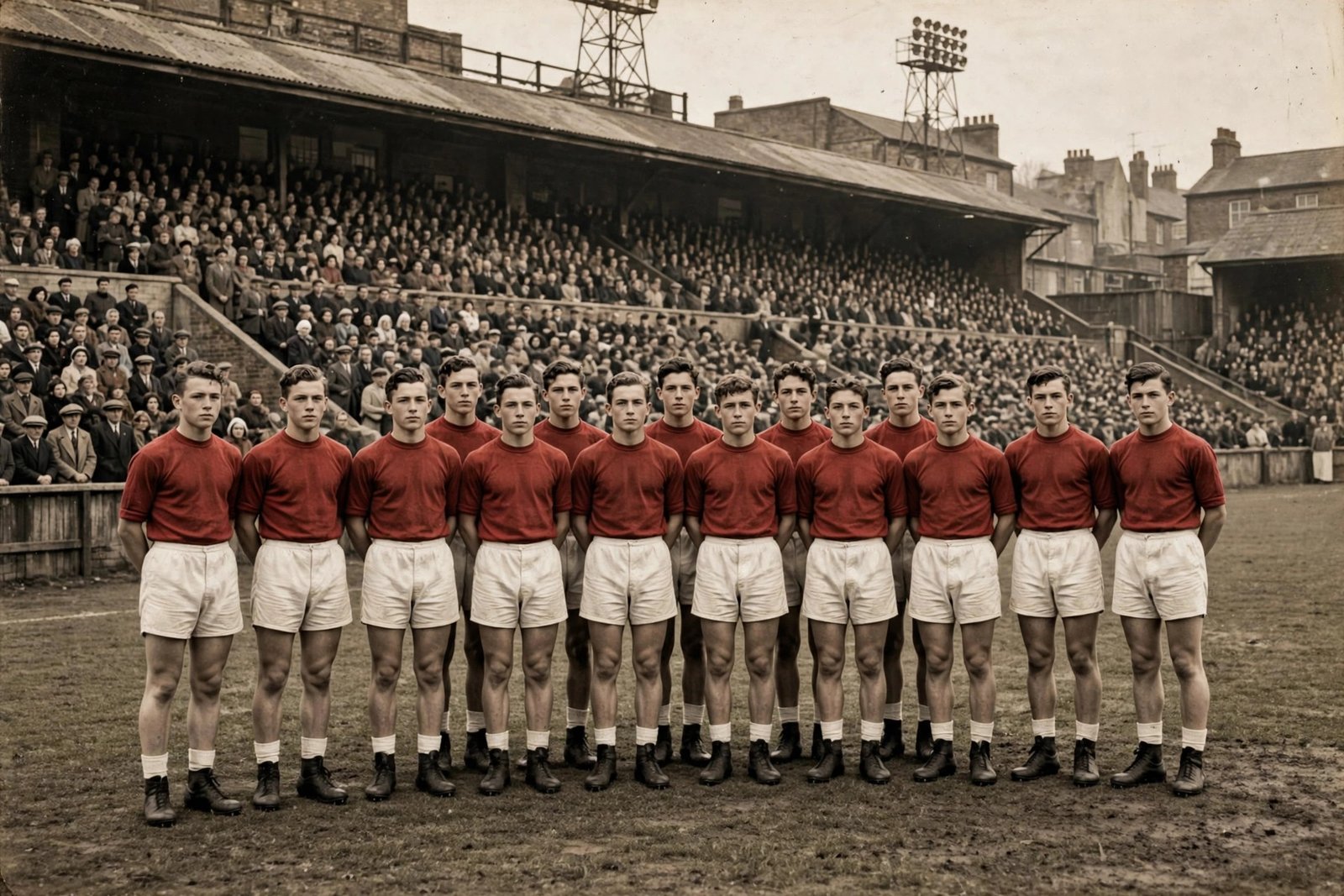
Every Manchester United supporter knows the words “Busby Babes”, and most know them before they fully understand them. They were the team Matt Busby built from the club’s own youth system in the 1950s — boys, most of them, who grew up together, played with a joy that filled grounds across England, and were on the verge of becoming one of the great sides of European football. What happened to them in Munich on 6 February 1958 is the defining tragedy of this club’s history, and the rebuilding that followed is its defining story. Both deserve to be told carefully, and told straight.
The Team That Busby Built
Busby’s revolution was trust. Where other managers bought experience, he promoted teenagers: Duncan Edwards, a midfielder of such complete talent that contemporaries described him as the finest player of his generation in waiting; captain Roger Byrne; the goalscorer Tommy Taylor; Eddie Colman, David Pegg, Mark Jones, Geoff Bent, Billy Whelan and more. The Babes won the league championship in 1956 and again in 1957 with a side whose average age was around 22, and Busby — against the wishes of the English football authorities — took them into the European Cup, believing English football had to test itself against the continent’s best. In February 1958 they travelled to Belgrade and drew 3-3 with Red Star to reach the semi-finals, 5-4 on aggregate. They were flying home in the highest of spirits. The club’s youth tradition did not end with them: it is the thread that runs through everything United have tried to be since, down to the Class of ’92 and the academy debates of today.
6 February 1958
The facts should be stated plainly. The team’s charter aircraft stopped at Munich to refuel on the journey home. Twice, in falling snow, take-off was aborted. On the third attempt, the plane failed to gain enough speed on the slush-covered runway, overshot, and crashed. Of the 44 people on board, 23 lost their lives. Among them were eight United players: Geoff Bent, Roger Byrne, Eddie Colman, Mark Jones, David Pegg, Tommy Taylor and Billy Whelan, and Duncan Edwards — who fought for fifteen days in hospital before dying of his injuries, aged 21. Three members of the club’s staff died, as did journalists — among them the former England goalkeeper Frank Swift — aircrew and fellow passengers. Matt Busby himself was gravely injured, twice read the last rites, and spent weeks in hospital before learning the full toll. Goalkeeper Harry Gregg, who had survived the impact, returned repeatedly to the wreckage to help rescue those trapped inside. There is no embellishment that improves this story, and none is needed.
The Club That Refused to Die
What happened next was an act of collective will. Busby’s assistant Jimmy Murphy — who had missed the trip because he was away managing Wales — took charge of a shattered club and, with a patched-up team of reserves, loanees and survivors, somehow kept United playing. Nineteen days after the disaster, a United side took the field at Old Trafford against Sheffield Wednesday, and the city turned out in mourning and defiance. That makeshift team reached the FA Cup final that May, losing to Bolton — a defeat that barely mattered next to the simple fact of being there. The Munich clock on the corner of Old Trafford still marks the time and date, and the club and its supporters have kept the memory every February since: the memorial, the minute’s silence, the Flowers of Manchester. Remembrance at United is not an anniversary obligation. It is woven into what the club believes it is.
The Rebuild
Busby recovered, returned, and did the hardest thing in sport: he built the team again. It took years and it took patience — new signings blended with the survivors, above all Bobby Charlton, who had been pulled from the wreckage and became the rebuild’s beating heart, and defender Bill Foulkes, who played on through all of it. The FA Cup came first, in 1963. Then the league title in 1965, and again in 1967. And on 29 May 1968, at Wembley, ten years after Munich, United beat Benfica 4-1 after extra time to win the European Cup — the first English club to do so. Charlton scored twice. Foulkes was immense. Busby, who had briefly considered resigning when the scale of the loss reached him in hospital, stood on the pitch with the trophy he had chased since the Babes were boys. He dedicated it to the players who had died. No trophy in football history has carried more meaning, and it takes its place at the summit of the greatest moments in Old Trafford’s history for reasons that go far beyond the match itself.
Why It Still Matters
It would be easy to treat this as history — old photographs, a clock, a plaque. But the Munich story is the reason certain things at United are not negotiable: the commitment to young players, the belief that the club belongs to something bigger than its current squad, the understanding among supporters that loyalty is measured in the worst weeks, not the best ones. The Babes never got to become what they were going to become. The club’s promise, renewed by every generation since, is that they are not forgotten — and that the team built in their shadow should always try to play, and to live, in a way worthy of them. We will never die, the song says. It is not really a song. It is a vow.
