


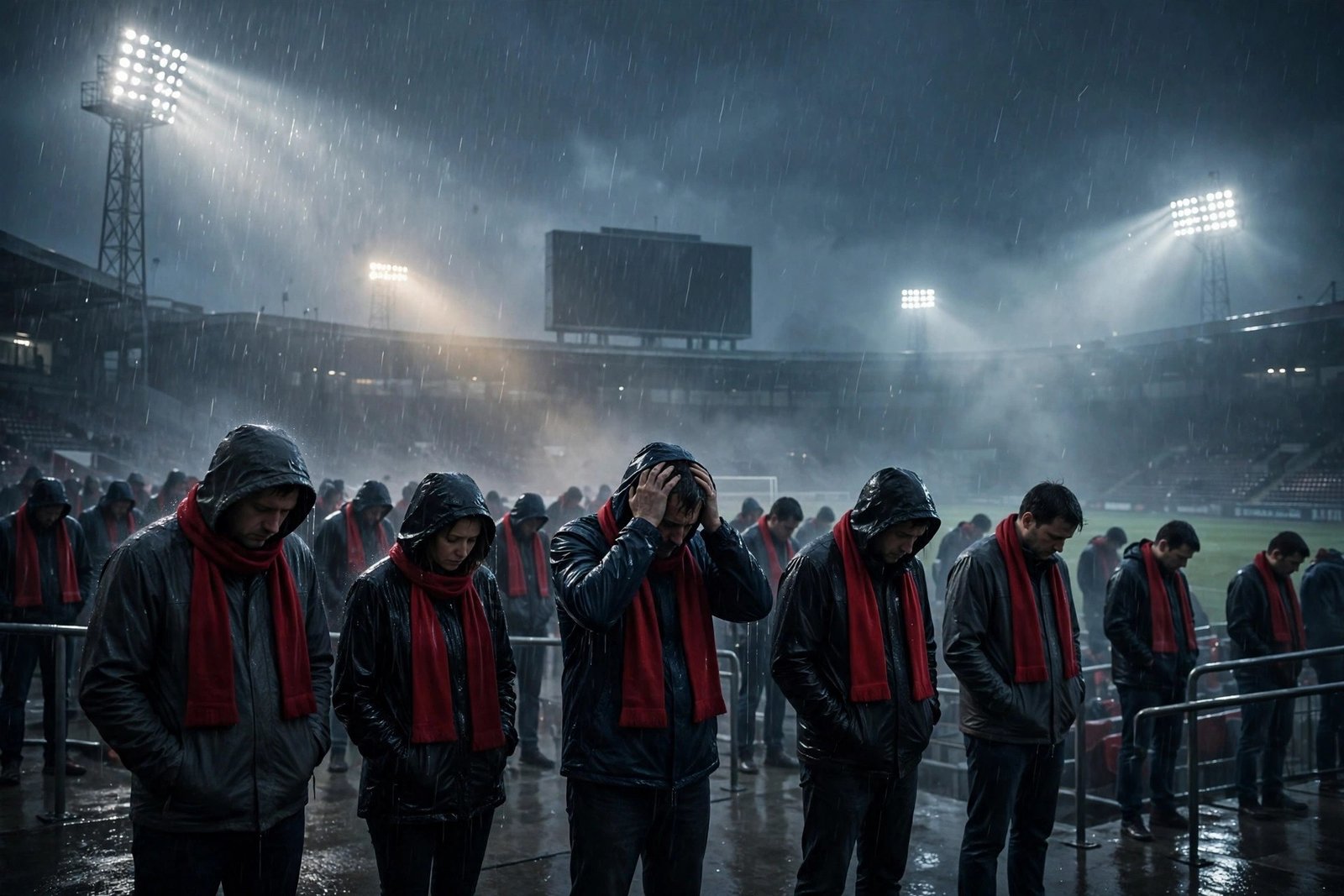
Manchester United’s biggest ever defeat is 7-0. No side has ever beaten United by eight — but four have beaten them by seven, and the four matches span almost a century: Blackburn Rovers in 1926, Aston Villa in 1930, Wolverhampton Wanderers in 1931 and, after a gap of more than ninety years, Liverpool in 2023. Every one of them came away from home. Every one of them has a story. Here they are, in full — plus the heaviest defeats Old Trafford itself has ever witnessed.
Blackburn Rovers 7-0 Manchester United — 10 April 1926
The first 7-0 arrived at Ewood Park in the spring of 1926, against a United side that was, by the standards of what came later, an ordinary First Division team finding its feet between the wars. There was no television footage, no social media meltdown — just a long train ride home and a scoreline that entered the record books quietly and stayed there. What makes it remarkable in hindsight is simply that it stood. United would go on to become the most famous club in England, through the Busby era and the Ferguson era, and for 97 years nobody ever beat them by more than Blackburn did that afternoon. The record was equalled three times. It has never been beaten.
Aston Villa 7-0 Manchester United — 27 December 1930
The second came in the middle of the worst season in United’s history. The 1930-31 campaign began with United losing their opening twelve league matches — still a notorious club record — and by the time they travelled to Villa Park two days after Christmas, relegation was already a formality waiting to happen. The opposition could hardly have been crueller: that Aston Villa side was one of the most attack-drunk teams English football has ever produced, scoring 128 league goals in a single season. United were duly dismantled 7-0, finished the season bottom of the First Division, and slid into the Second Division. If the Blackburn defeat was a bad day, this one was a symptom: a club at its lowest ebb, beaten by the division’s great entertainers at the exact moment it could least defend itself.
Wolves 7-0 Manchester United — 26 December 1931
Almost exactly a year later, on Boxing Day 1931, it happened again — and this time in the Second Division. United, still in decline, visited a Wolverhampton Wanderers side powering towards the Second Division championship and promotion, and lost 7-0 at Molineux. Three seven-goal defeats in under six years, all away, all in the space between the club’s first golden age and its Busby-led rebirth. Then — silence. Generation after generation of United supporters grew up with the 7-0 as a museum piece, a relic of the black-and-white era that modern United, with their resources and their standards, would surely never repeat. That assumption lasted until a Sunday afternoon in March 2023.
Liverpool 7-0 Manchester United — 5 March 2023
The modern entry is the one that will be remembered longest, precisely because nobody saw it coming. Erik ten Hag’s United arrived at Anfield on 5 March 2023 in form, a week after winning the Carabao Cup, and for 43 minutes they competed. Cody Gakpo’s opener just before half-time changed everything. What followed was the most extraordinary second half in the fixture’s history: Gakpo again, Darwin Núñez twice, Mohamed Salah twice — the second of them making Salah Liverpool’s record Premier League scorer — and a late seventh from Roberto Firmino. Six goals in one half, against their fiercest rivals, in a match that equalled the club record set in 1931. Ten Hag called his players “unprofessional” afterwards, and the result instantly took its place in the all-time head-to-head record as Liverpool’s biggest ever win in the fixture, surpassing even their 7-1 of 1895. It is, by a distance, the heaviest defeat of the Premier League era — United’s and, as a margin, one of the biggest the competition has seen any club suffer.
The Heaviest Home Defeats
Old Trafford has never seen a 7-0, but the home record book has its own dark chapters. United’s record home defeat is a six-goal margin, and it has happened three times. Aston Villa won 6-0 at Old Trafford on 14 March 1914. Newcastle United won 7-1 there on 10 September 1927. And Huddersfield Town won 6-0 on 10 September 1930 — the same date, three years apart, in the middle of that miserable pre-war slide. The modern era added two infamous five-goal home defeats in the Premier League record books: the 6-1 by Manchester City on 23 October 2011, Balotelli’s “Why Always Me?” derby, a defeat Sir Alex Ferguson called his worst day and one that eventually cost United the title on goal difference; and the 6-1 by Tottenham Hotspur on 4 October 2020, delivered by José Mourinho against his former club with United down to ten men. Add Liverpool’s 5-0 at Old Trafford in October 2021 and the pattern is clear: the fortress has been breached before, but seven has only ever happened on the road.
Does a Record Defeat Actually Matter?
More than the record win does, strangely. Ask United fans about the 10-0 against Anderlecht and most know it as a trivia answer — ask about Anfield 2023 and they can tell you where they were. Heavy defeats mark eras: the 1930 and 1931 hammerings belong to a club in freefall towards the Second Division; the 2023 one belongs to a rebuild that had real momentum and suddenly had to prove it could absorb a humiliation. There is also this: a record that has survived for a century, through the club’s greatest teams and its weakest, tells you something true about football — that no margin of superiority is permanent, and that the badge guarantees nothing on any given Sunday. United’s history is rightly told through the full honours list and our guide to the biggest win in the club’s history, the 10-0 that no opponent has ever bettered from the other side. But the four 7-0s are part of the same story. The club that has never been beaten by eight has been beaten by seven four times — and has spent a hundred years making sure the number never grows.
