


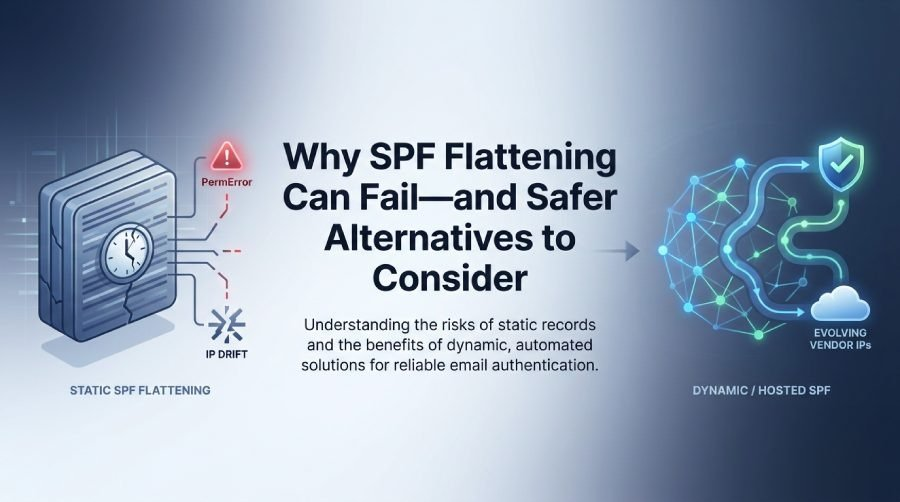
SPF flattening is the practice of replacing SPF include statements with the actual IP ranges they resolve to, creating a flattened record made up of pre-resolved IP addresses. Instead of publishing an SPF record such as v=spf1 include:_spf.google.com include:sendgrid.net ~all, a team may use an SPF flattening tool to expand each include: mechanism into the underlying IP addresses authorized to send mail.
Organizations use SPF flattening because modern email authentication environments are complicated. A single domain may rely on Google Workspace or Microsoft 365 for corporate mail, SendGrid or Amazon SES for transactional email, Mailchimp, Mandrill, or Sendinblue for campaigns, Zendesk for support, Salesforce or Zoho for CRM workflows, and other Email vendors across CRMs and Marketing platforms. Each platform may publish its own SPF record, often using the include: mechanism to reference still more records.
How flattening changes the SPF record
A standard SPF record often depends on DNS lookups at authentication time. A static SPF record created through SPF flattening reduces those lookups by placing authorized IPs directly into DNS TXT records. In theory, this makes SPF validation simpler for Mailbox providers such as Outlook.com, because the receiver can evaluate the sender against listed IPs without resolving multiple nested SPF includes.
However, that simplicity is also the weakness. Manual flattening creates a static SPF record that represents one moment in time. If the original vendor’s infrastructure changes, the static SPF record may no longer reflect current authorized IPs.
Static flattening, dynamic flattening, and hosted SPF
There are several approaches. Static Flattening Tools generate a static SPF record once, leaving SPF record maintenance to the domain owner. Manual flattening is similar, except the administrator expands the records by hand or with scripts. Dynamic SPF flattening and Dynamic SPF Solutions use dynamic mapping or automatic updates to keep records aligned with vendor IP changes.
A hosted SPF model goes further by outsourcing SPF configuration management to a hosted SPF service. With hosted SPF, the domain publishes a lightweight reference while the provider handles SPF monitoring, SPF lookup count control, and authentication checks. Solutions such as PowerDMARC, PowerSPF, PowerDMARC’s SPF Flattening Tool, and AutoSPF are examples of tools teams may evaluate when moving beyond manual flattening.
The DNS Lookup Limit Problem SPF Flattening Tries to Solve
The main reason teams consider SPF flattening is the DNS lookup limit defined in RFC 7208. SPF allows a maximum of 10 DNS-mechanism lookups during evaluation. This is commonly called the 10 DNS lookup limit or DNS lookup limit. If the SPF record exceeds that DNS lookup limit, the receiver returns a PermError, and SPF may fail even when the message comes from a legitimate service.
The mechanisms that count toward DNS lookups include include, a, mx, ptr, exists, and redirect. The include: mechanism is the most common culprit because vendors frequently use SPF include statements that point to other SPF records. Those records can contain nested mechanisms, nested SPF includes, and additional DNS lookups of their own.
Why nested mechanisms cause PermError
An SPF record may appear short but still exceed the DNS lookup limit. For example, a domain may include Google Workspace, Microsoft 365, Mailchimp, Zendesk, Salesforce, and Amazon SES. Each include: mechanism may expand into nested mechanisms controlled by those providers. The administrator sees only a few entries, but the receiving server follows the full chain.
Once the SPF lookup count goes beyond the DNS lookup limit, SPF validation can return PermError. That can reduce SPF pass/fail rates and lead to SPF failures in reports, especially when paired with a DMARC policy that depends on aligned SPF or DKIM. SPF flattening tries to prevent this by replacing the include: mechanism and nested mechanisms with direct IP ranges.
Why SPF Flattening Can Fail: IP Drift, Stale Records, and Maintenance Gaps
SPF flattening can fail because the internet infrastructure behind email platforms is not static. Email vendors frequently add, remove, and rotate IP ranges. Cloud-based senders such as SendGrid, Amazon SES, Mailchimp, Mandrill, and Microsoft 365 may adjust their sending infrastructure for capacity, security, routing, or regional compliance reasons.
When teams rely on manual flattening, the resulting static SPF record can become stale. This is sometimes called IP drift: the flattened record contains old IPs while the vendor has started sending from new ones. Messages from legitimate third-party email senders then fail SPF authentication checks.
Vendor IP changes and stale authorized IPs
Vendor IP changes are one of the biggest risks of static SPF flattening. A vendor may update its published SPF record, but your flattened record will not automatically inherit that change. If the domain owner does not perform an SPF audit, compare current vendor records, and update DNS TXT records, legitimate mail can begin failing.
This is especially dangerous for high-volume senders. A stale SPF record can cause SPF failures for password resets, invoices, marketing campaigns, support notifications, and CRM alerts. These SPF failures may appear gradually in DMARC aggregate data or suddenly after a vendor migration.
Where manual processes break down
Manual flattening creates a recurring maintenance burden. Someone must monitor each vendor’s SPF record, detect IP address changes, update the static SPF record, check for oversized DNS records, and confirm SPF validation. Even when a team uses an SPF checker or SPF checker tool, the process can fail if checks are infrequent or ownership is unclear.
Record size, DNS behavior, and SPF Folding
Flattening can also fail because DNS has practical size constraints. A static SPF record may grow so large that it causes record bloat or oversized DNS records. Some DNS Registrar interfaces do not handle long DNS TXT values cleanly, and receivers may have trouble processing improperly formatted records.
SPF Folding is sometimes used to split long SPF content across multiple character strings within a single DNS TXT record. This can help with formatting, but it does not solve the deeper problem: an over-flattened SPF record can become difficult to manage, audit, and trust.
Security and Deliverability Risks of Over-Flattened SPF Records
Over-flattening is not just an administrative inconvenience. It can weaken email authentication and create security exposure. SPF is part of a broader email authentication stack that includes DKIM and DMARC. If SPF is inaccurate, too broad, or stale, SPF policy enforcement becomes unreliable.

Overly broad records can authorize the wrong senders
A flattened SPF record may include large IP blocks from shared email platforms. Those IPs may be legitimate for the vendor, but not necessarily dedicated to your organization. If a record includes more authorized IPs than necessary, the domain’s SPF configuration becomes overly permissive.
This matters because SPF is intended to define which servers are authorized to send on behalf of a domain. Overbroad authorized IPs can increase the attack surface, while stale entries can keep old services authorized long after a contract ends. This is why SPF audit practices should include third-party email senders, active business owners, and alignment with DMARC and DKIM.
A poor SPF configuration can also hurt email deliverability. Mailbox providers evaluate authentication standards holistically. Repeated SPF failures, inconsistent DMARC alignment, and poorly maintained DNS TXT records can all affect reputation signals.
Safer Alternatives: SPF Macros, Subdomain Segmentation, Vendor Audits, and Managed SPF
A safer operating model for SPF
A mature approach begins with an SPF audit. Identify all third-party email senders, remove abandoned vendors, and verify whether each platform still needs to send from the organizational domain. Many SPF failures are caused by outdated entries rather than genuine infrastructure needs.

From there, consider several safer controls:
- SPF Macros and macro-based SPF: SPF Macros can help create more flexible authorization patterns in advanced environments. Macro-based SPF should be designed carefully, but it can reduce the need for excessive static SPF flattening.
- Subdomain segmentation: Use separate subdomains for different sending streams, such as mail.example.com for marketing, notify.example.com for product alerts, or support.example.com for Zendesk. This keeps each SPF record smaller and reduces dependence on nested mechanisms.
- Vendor audits: Review Google Workspace, Microsoft 365, SendGrid, Mailchimp, Salesforce, Zoho, Amazon SES, Sendinblue, and other platforms regularly. Remove inactive SPF include statements and confirm current sending requirements.
- Managed or hosted SPF: A hosted SPF solution or hosted SPF service can manage DNS lookup limit pressure using dynamic mapping, automatic updates, and ongoing SPF monitoring.
- Better tooling: Use an SPF Checker, SPF checker tool, or SPF flattening tool to validate syntax, lookup count, and the effect of nested mechanisms before publishing changes.
The key is to avoid treating SPF flattening as a one-and-done fix. A static SPF record may solve today’s DNS lookup limit problem while creating tomorrow’s deliverability incident. A well-managed approach combines SPF audit and cleanup, hosted SPF where appropriate, SPF Macros for advanced cases, subdomain segmentation for complex senders, and regular review of third-party email senders.
