
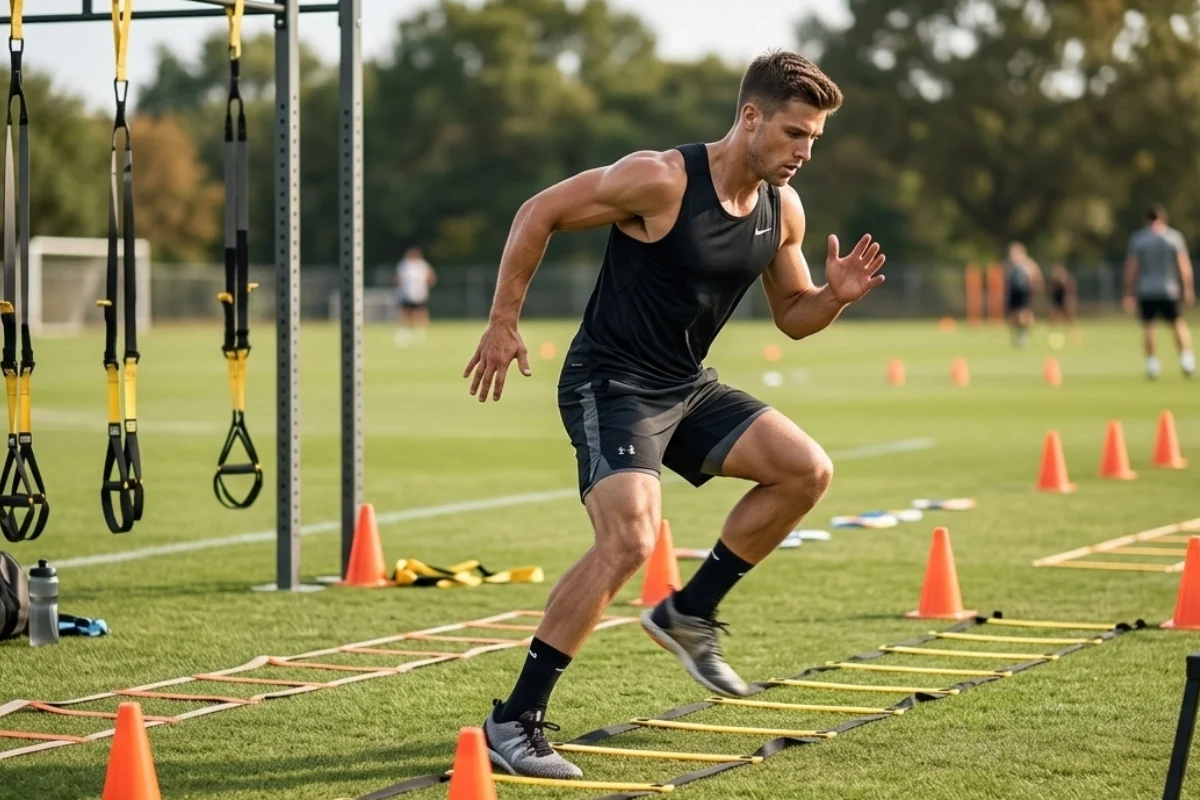
Football training naturally revolves around the ball, but some of the physical qualities that make a difference on matchday can also be developed in the gym.
Players need to accelerate, change direction, hold off opponents, jump, recover from repeated runs and remain effective as a match progresses. Gym training can complement technical and tactical sessions by targeting the strength, power and conditioning behind those actions.
The key is choosing exercises with a clear purpose rather than simply becoming stronger for the sake of it.
Squats for Lower-Body Strength
Squats are a natural starting point because football places considerable demands on the legs. Different squat variations can develop the quads, glutes and other muscles involved in producing force. That strength provides a useful foundation for actions such as sprinting, jumping and competing physically.
Single-leg variations, including split squats, can be particularly useful because footballers regularly accelerate, strike the ball and change direction from one leg.
Lunges for Strength and Stability
Football rarely involves perfectly symmetrical movements, which makes lunges another useful addition.
Forward, reverse and lateral lunges challenge the lower body while requiring balance and control. Lateral variations are particularly interesting because players frequently have to move sideways when defending, pressing or adjusting their position.
Rather than focusing solely on heavy resistance, players can prioritise controlled movement and gradually increase the challenge.
Box Jumps for Explosive Movement
Strength is valuable, but footballers also need to produce force quickly. Plyometric exercises such as box jumps can introduce an explosive element to gym training. Jumping and landing require players to generate power while maintaining control, qualities that can be useful when competing for headers or accelerating into space.
Other jumping exercises, including lateral bounds and single-leg hops, can provide further variation.
Battle Ropes for Conditioning
Football involves repeated periods of intense activity separated by lower-intensity movement. Conditioning exercises can help prepare players for that pattern.
Mirafit’s battle rope range can be incorporated into interval or circuit sessions using exercises such as alternating waves and rope slams. Battle ropes engage several muscle groups while simultaneously increasing cardiovascular demand, making them suitable for short, high-intensity conditioning efforts.
They can also provide an alternative to adding more running volume when players want greater variety in their conditioning sessions.
Sled Pushes and Pulls for Leg Drive
Weighted sled exercises combine strength and conditioning in a movement that encourages players to drive forcefully through their legs.
Sled pushes can be completed over relatively short distances, making them easy to incorporate into gym circuits. Pulling or dragging a sled creates a different challenge and can be adapted according to the player’s training goals.
The resistance can also be adjusted, allowing the exercise to focus more heavily on strength or faster movement.
Rows for Upper-Body Strength
Football is primarily played with the feet, but upper-body strength should not be overlooked. Players regularly use their bodies to shield possession, maintain balance, and compete with opponents. Rowing movements can strengthen the upper back and arms while also requiring good posture and trunk control.
Dumbbell rows, cable rows and barbell variations can all be used depending on the equipment available and the player’s experience.
Core Exercises for Better Control
The core connects movements between the upper and lower body, making it relevant to almost every action on the pitch. Planks, carries and anti-rotation exercises can challenge players to maintain stability while forces act against them. Rotational movements can also be introduced where appropriate.
The aim is not necessarily to complete hundreds of repetitions. Developing the ability to control the torso under resistance can provide a more practical training objective.
Making Gym Work Part of the Bigger Picture
Gym training cannot replace time spent playing football. A stronger squat will not automatically improve someone’s first touch, and better conditioning cannot replace tactical awareness.
Its value comes from supporting the physical qualities that football repeatedly demands.
Combining lower-body strength work, explosive exercises, conditioning and core training can help create a broader athletic foundation. When that work sits alongside regular technical practice, recovery and match preparation, the gym becomes another tool for helping footballers prepare for what happens on the pitch.
