


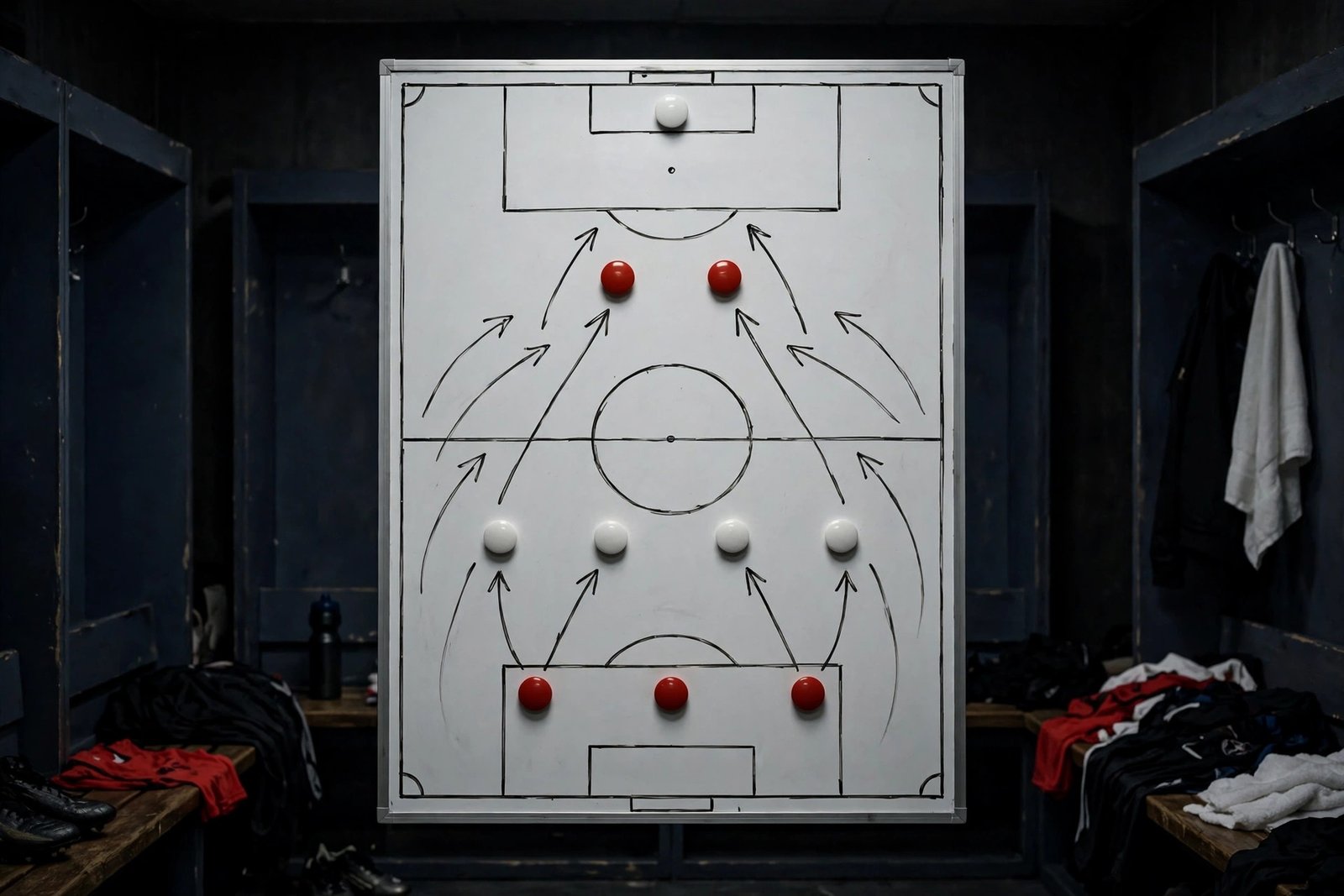
Few selection debates at Manchester United are as honest as this one. Diogo Dalot and Noussair Mazraoui are both good players, both internationals, both capable of playing on either flank — and in Michael Carrick’s 3-4-2-1, as our full tactical breakdown of Carrick’s system sets out, the right wing-back is not a supporting role. He is the width, the first presser, the overlapping runner and, on the days the 10s are crowded out, half the attack. Two men, one shirt, and genuinely different answers to the same question. So who should be first choice?
The Job Description
Start with what the role actually demands in this team. Because the twin 10s play narrow, the wing-back alone stretches the pitch horizontally; without his runs, United become a team playing in a corridor. He must arrive at the back post when the left side builds, deliver early and accurately, and then sprint sixty yards back to become a fifth defender when possession turns over — dozens of times a game, every game. He also defends the widest channel of a back three, which means the league’s best left-wingers are his weekly examination. It is the most physically and tactically demanding position in the side, which is why the debate matters more than the usual “who starts” argument.
The Case for Dalot
Dalot’s case is built on engine and durability. He is one of the squad’s great athletes — the repeated high-speed runs the role requires are his natural habitat — and his crossing volume from the right gives United something nobody else in the squad provides as consistently: early, whipped delivery into the corridor Sesko and Cunha attack. He is also the more flexible man, genuinely two-sided, comfortable stepping in as a full-back in a four or covering the left when injuries demand. The case against is equally familiar. Dalot’s ceiling games are excellent, but his floor games — the loose pass in build-up, the switched-off back-post moment — have cost United before, and in a back three, the wing-back’s defensive lapse is exposed faster than a full-back’s would be. There is also a fair counterpoint his defenders make: few players in the squad have improved as steadily across their United careers, season on season, role on role, and his personality — vocal, demanding, visibly invested — is part of why successive managers have kept faith with him through every tactical rebuild.
The Case for Mazraoui
Mazraoui is the technician’s choice, and this system loves technicians. The Moroccan is press-resistant in a way few defenders in the league are: he receives under pressure, turns out of trouble, and plays the short, secure passes that let United’s build-up breathe — the exact quality the Chelsea defeat screamed for when the first line of the press kept breaking the team’s rhythm. Defensively, one against one, he is the more reliable duellist of the two, positionally intelligent and calm in the wide channel. The questions are different ones. He does not offer Dalot’s crossing threat or relentless overlap, and across his career the availability question has followed him — a wing-back asked to sprint a kilometre of high-intensity distance twice a week needs a body that holds up, and Mazraoui’s fitness record across a long season has been interrupted often enough to matter in a squad already full of treatment-room residents.
The Amad Factor
Complicating everything — happily — is Amad Diallo’s reinvention as a wing-back, one of this season’s genuine tactical successes. Amad changes the question from “Dalot or Mazraoui?” to “which of them plays with Amad, and where?” Against deep blocks, Amad on the right with a secure defender behind him is a combination Carrick can trust; in the biggest games, Mazraoui’s defensive security with Amad ahead of him on the right of the 10s is another. And because both Dalot and Mazraoui can operate on the left, the loser of this debate is not exiled — he becomes the answer on the other flank, where United’s options thin out far quicker. This is not a redundancy problem. It is the squad’s one position of genuine, usable depth.
The Verdict
Our answer is conditional, but it is an answer: Mazraoui, first choice, for the games that define the season. Carrick’s system lives or dies on its build-up surviving the press, and Mazraoui’s security in possession raises the whole team’s floor — the Chelsea lesson, learned the hard way, is that this United cannot afford a wing-back who gives the ball back cheaply. Dalot, though, is not a deputy in any normal sense: he is the better attacking weapon against deep defences, the left side’s insurance policy, and the man whose engine you want in the winter pile-up of fixtures. The truth of modern squads is that “first choice” now means “first name in the biggest games”, and on that definition Mazraoui edges it — narrowly, and with Dalot close enough behind him that one loose month could swap the order. That is not a problem for Carrick. It is the healthiest competition in his squad.
