


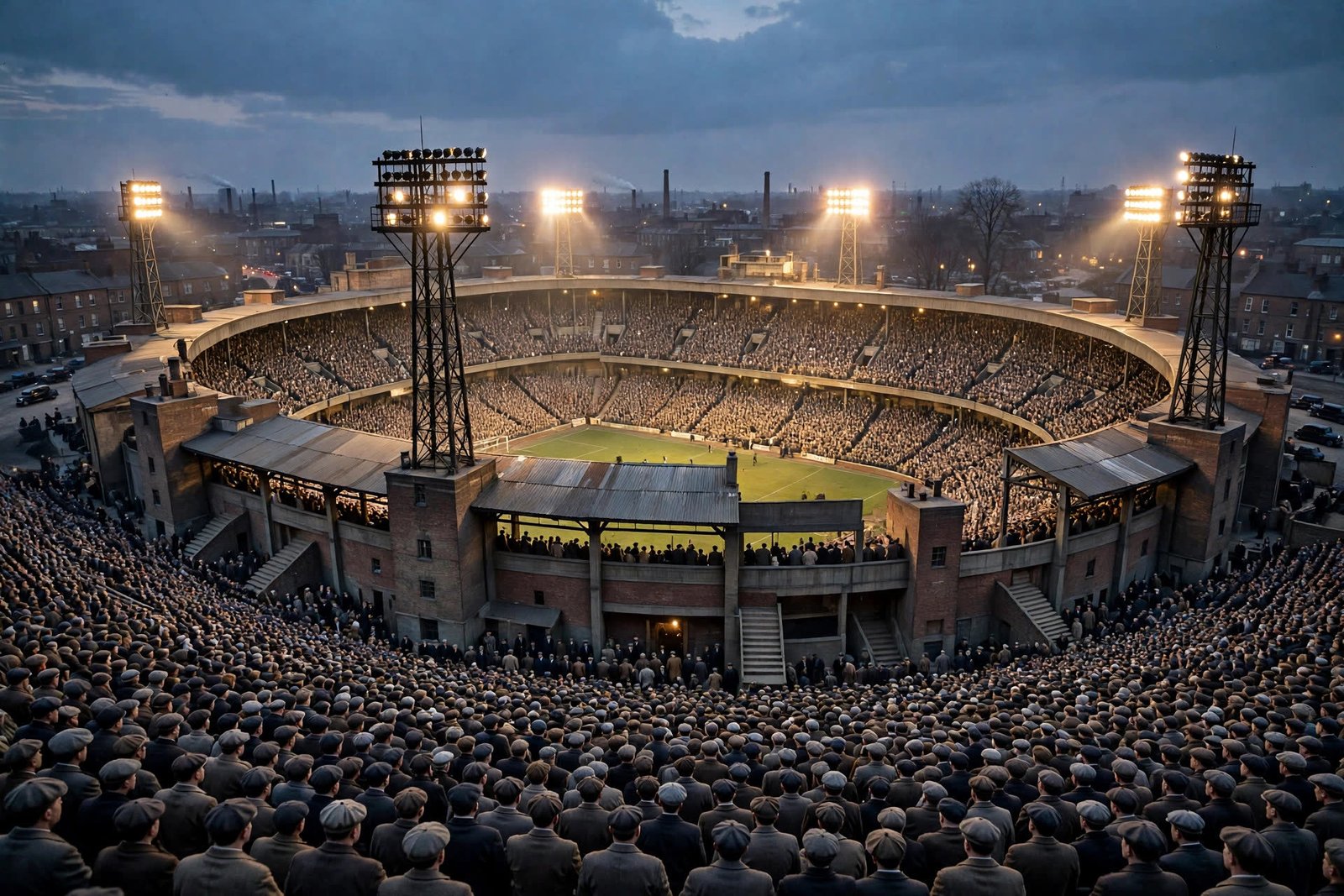
Every great stadium has a record crowd, and almost always it came for the home team on a famous night. Old Trafford is the exception. The biggest crowd ever recorded inside Manchester United’s ground — 76,962 people — did not come to watch United at all. They came on 25 March 1939 to watch Wolverhampton Wanderers play Grimsby Town in an FA Cup semi-final. United were not involved, and yet the record they set that day has stood for more than 85 years, through world wars, rebuilds, expansions and the all-seater era. This is the story of the strangest record in English football — and why it will probably never be broken.
The day: 25 March 1939, Wolves 5-0 Grimsby
The match itself was one-sided. Wolves, one of the great sides of the late 1930s, beat Grimsby 5-0 to reach the FA Cup final, where they would lose to Portsmouth. Grimsby were playing in their first ever FA Cup semi-final, and their supporters travelled in huge numbers — the Mariners’ official history still calls it the landmark day in the club’s story. But the result is the least interesting part of the day. What mattered was the crowd: 76,962 people squeezed into a ground that was built for standing, not sitting. There were no fatalities, which given the density of the crowd and the standards of the time is remarkable in itself, and the figure remains among the ten highest ever recorded for a club match outside Wembley.
Why was the semi-final at Old Trafford at all? In those days FA Cup semi-finals were played at neutral grounds, and Old Trafford was one of the most trusted neutral venues in the country. The ground had already staged the 1911 FA Cup final replay and the 1915 final itself, and it would go on hosting semi-finals for decades. A neutral semi-final at a big ground was a national event in the 1930s in a way that is hard to imagine now — there was no television to watch it on, so if you wanted to see it, you went. Nearly 77,000 people did.
Why no United game has ever beaten it
The honest answer is that the record belongs to a different era of football, one that no longer exists. In 1939 Old Trafford was a standing ground. Terracing packed people in shoulder to shoulder, and the official capacity was far higher than anything the modern stadium allows. The ground opened on 19 February 1910 against Liverpool — Liverpool won 4-3 — with an original design meant for around 77,000 after budget cuts forced the architect Archibald Leitch to scale back from 100,000. In other words, the 1939 crowd was close to the ground’s absolute limit, in a configuration that safety law would never permit again.
The all-seater era changed the maths completely. After the Taylor Report, Old Trafford became all-seater, and the record for a seated crowd is 76,098, set on 31 March 2007 when United beat Blackburn Rovers 4-1 in the Premier League. That night just 114 seats were empty out of a capacity of 76,212. It is United’s own record home attendance — and it is still 864 short of the 1939 figure. The current capacity is 74,310, which means the 1939 record is now mathematically unbeatable. Unless the stadium is expanded or replaced, no crowd at Old Trafford will ever again reach 76,962.
What the record says about the FA Cup — and about Old Trafford
There is a temptation to treat 76,962 as a curiosity, a number from a black-and-white age. It is more than that. It is a measure of what the FA Cup meant in 1939, when a semi-final between two provincial clubs could fill the biggest ground in the country with people who had travelled by train and bus from Wolverhampton and Grimsby, many of whom had never seen either team before. It is also a measure of Old Trafford’s standing: the ground was trusted with the biggest occasions in the country long before it was a fortress for one club. It hosted the 1966 World Cup, Euro 96, the 2003 Champions League final between Milan and Juventus, and Olympic football in 2012 — a neutral venue for the biggest nights, exactly as it was in 1939.
The record survived a war
Two years after the record was set, the ground that held it was nearly destroyed. German bombing in March 1941 wrecked Old Trafford so badly that United played their home games at Manchester City’s Maine Road for eight years, not returning until 1949. The record crowd of 1939 watched football in a stadium that would not exist in the same form again — the ground was rebuilt, re-roofed and re-imagined, and the terracing that packed in 76,962 people was eventually replaced by seats that hold far fewer. And still the number survived, because nobody has ever been able to put that many people into the rebuilt ground. The biggest non-competitive crowd, for comparison, was 74,731 for Paul Scholes’ testimonial against the New York Cosmos in August 2011 — a full house for a farewell, and still more than two thousand short of a semi-final between two other clubs in 1939.
That is the real story of the record. Old Trafford’s biggest crowd came for a game United were not playing in, at a ground that belonged that day to English football as a whole. The figure has survived the war that damaged the stadium, the rebuilding, the Munich era, the Ferguson era and every expansion since. It will survive a while longer yet — because the only way to beat it is to build a bigger Old Trafford.
