


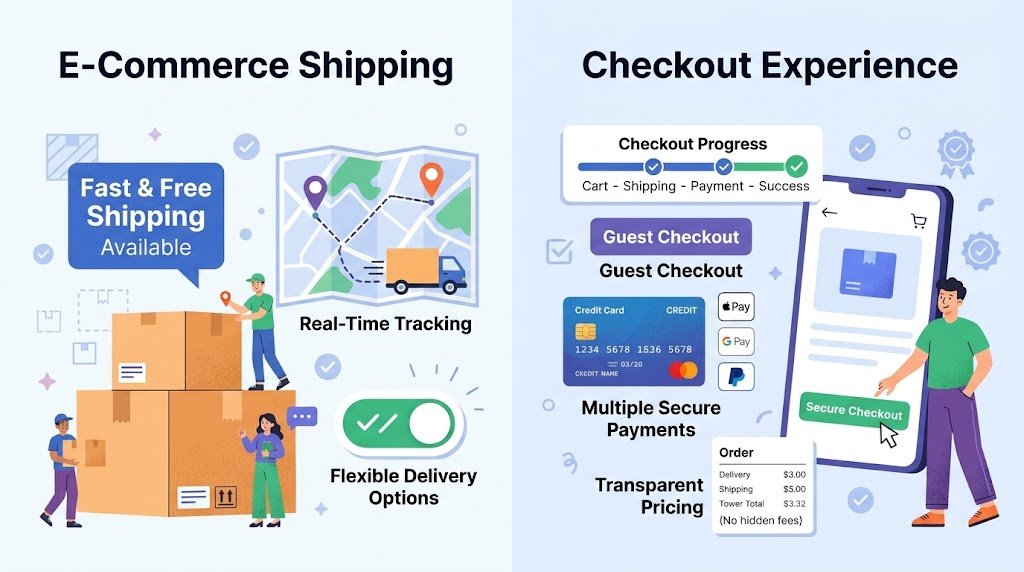
E-commerce shipping plays an important role in the overall online shopping experience. Customers expect clear delivery information, reasonable shipping costs, and reliable arrival estimates before completing a purchase. When these expectations are not met, shoppers may abandon their carts or choose a competitor that offers a more convenient delivery experience. For online retailers, developing an effective shipping strategy is therefore essential for maintaining customer satisfaction and supporting long-term business growth.
From calculating shipping rates to managing delivery expectations, several factors influence how customers perceive an online store. Understanding common shipping challenges and implementing practical solutions can help businesses streamline their operations while making checkout easier for customers.
1. Provide Clear and Accurate Shipping Costs
Unexpected shipping charges are a common reason customers abandon their shopping carts. A product may appear affordable when customers first view it, but additional delivery fees can make the final price less attractive. If these costs only appear at the last stage of checkout, shoppers may feel frustrated or misled.
Online retailers can reduce this problem by displaying shipping costs as early as possible. Shipping rates should reflect relevant factors such as package weight, dimensions, destination, delivery speed, and carrier pricing. Businesses that offer several shipping methods can allow customers to choose an option that fits their budget and schedule.
Accurate rate calculations also help retailers avoid charging too little or too much for delivery. Reviewing shipping rules regularly is particularly important when carrier prices, product ranges, or delivery destinations change.
2. Offer Multiple Delivery Options
Different customers have different delivery priorities. Some prefer the lowest available shipping cost, while others are willing to pay more for faster delivery. Providing a selection of suitable options allows shoppers to make decisions based on their individual needs.
Common choices include standard shipping, express delivery, scheduled delivery, and local pickup. Depending on the business model and available logistics services, retailers may also offer same-day delivery in selected locations.
The key is to provide meaningful choices without overwhelming customers. Too many similar options can make checkout confusing, particularly when delivery methods have unclear names or overlapping delivery estimates.
Retailers should explain the differences between available services in straightforward language. Showing the expected delivery timeframe alongside each option helps customers understand the value of their choices and select the most appropriate method.
3. Display Realistic Delivery Dates
Delivery estimates influence purchasing decisions because customers often need to know when an order will arrive. A vague message such as “ships soon” may not provide enough information for someone purchasing a birthday gift, business supplies, or a time-sensitive item.
Businesses can improve transparency by displaying estimated delivery dates or clear delivery windows at checkout. These estimates should account for relevant factors, including the customer’s location, order processing time, warehouse schedules, carrier transit times, weekends, and public holidays.
Retailers should also distinguish between order processing and transportation. An item that takes two business days to prepare and another three days to ship may require five business days to reach the customer, rather than the shorter transit time alone.
Although no estimate can guarantee that every parcel will arrive on schedule, realistic expectations help reduce confusion and customer service inquiries. When delays occur, proactive notifications can reassure customers and explain what happens next.
4. Make International Shipping Easier to Understand
Selling internationally introduces additional complexities. Retailers must consider different carrier services, customs documentation, import duties, taxes, restricted products, and varying delivery times.
Customers may hesitate to place international orders when they cannot determine the total cost before payment. Unexpected customs charges after dispatch can also create dissatisfaction, even when the retailer has fulfilled the order correctly.
Where possible, businesses should explain whether duties and taxes are included in the checkout total or payable upon delivery. If these charges can be calculated in advance, presenting them clearly can help customers make informed purchasing decisions.
Retailers should also verify destination-specific shipping restrictions and ensure that customs information is accurate. Product descriptions, declared values, and other required details should be consistent with the actual shipment.
Clear communication is particularly important for international orders because customers may have limited visibility into customs procedures and local delivery arrangements.
5. Reduce Checkout Friction
A smooth checkout process should make it easy for customers to review their order, understand the total cost, and complete payment. Complicated shipping forms, unclear delivery choices, and unexpected changes in the final price can interrupt this process.
Retailers can improve the experience by reducing unnecessary form fields, supporting address validation where available, and presenting shipping methods in a consistent format. Customers should be able to understand delivery costs and estimated arrival times without navigating multiple pages.
Mobile optimization is equally important. Shipping information should remain readable on smaller screens, and customers should be able to select delivery options without difficulty. A checkout that works well on desktop computers but performs poorly on mobile devices can create unnecessary barriers to purchase.
Integrations between an e-commerce platform and shipping services can also help automate rate calculations and display relevant delivery information. For example, retailers researching a shopify ups integration may need to distinguish between UPS carrier shipping functionality and Shopify upsell applications. These serve different purposes: shipping integrations support delivery calculations and fulfillment, while upsell tools encourage customers to purchase additional products.
6. Prepare for Common Shipping Challenges
Even a well-organized shipping process can encounter problems. Incorrect addresses, inaccurate package measurements, carrier capacity limitations, inventory shortages, and severe weather can all affect delivery performance.
Businesses can reduce these risks by establishing clear internal procedures. Accurate inventory records help prevent orders from being accepted when products are unavailable. Standardized packing practices improve consistency, while checking parcel dimensions and weight helps reduce unexpected carrier adjustments.
Tracking information should be shared with customers when available, and support teams should have a clear process for handling delayed, damaged, or missing shipments.
It is also useful to monitor shipping performance over time. Metrics such as delivery delays, shipping cost per order, failed deliveries, and customer complaints can reveal recurring issues. Reviewing these indicators helps businesses identify where operational changes may have the greatest impact.
7. Use Shipping Data to Improve Performance
Shipping decisions should be based on more than individual customer complaints. Regularly analyzing order and delivery data helps retailers identify patterns and evaluate whether their shipping policies are working effectively.
For example, a high cart abandonment rate may indicate that delivery charges appear too late or exceed customer expectations. Frequent delivery inquiries could suggest that estimated arrival dates are unclear. Repeated address-related failures may indicate a need for better validation during checkout.
Retailers can also compare shipping costs across destinations, product categories, and delivery methods. This information can support decisions about free-shipping thresholds, packaging improvements, carrier selection, and warehouse allocation.
Any changes should be evaluated carefully. Offering free shipping may increase conversion rates, but it can also reduce profit margins if the additional expense is not reflected in product p
