


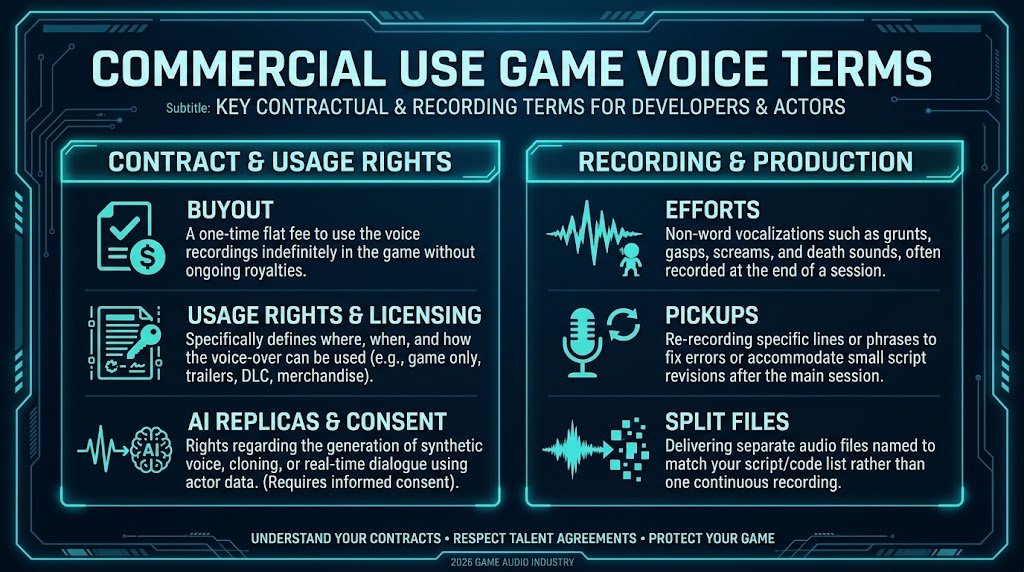
Commercial use game voice terms tell you whether AI-generated character lines can ship in a game you sell. Adobe Firefly’s AI voice generator is one straightforward option: Adobe says voiceovers made with its Firefly Speech Model are safe for commercial use, and free accounts get daily generations.
Picture a two-person studio finishing a narrative adventure game with 30 speaking characters. Hiring a full cast isn’t in the budget, so AI voices are the plan. Before recording a single line, though, the team needs answers to a few practical questions. Can the audio be bundled into a game that’s sold on Steam or consoles? Does the provider need credit? What changes if voices are generated live during play instead of ahead of time? Every platform answers these a little differently, and the answers live in its terms of service.
Do You Need a Commercial Use Game Publishing License for an AI Voice?
Most AI voice tools don’t sell a separate commercial use game publishing license. Instead, your rights to an AI voice come from your plan and the provider’s terms. When those terms allow commercial use, you can generally include the audio in a published game.
Check four points before you commit: whether your plan includes commercial rights, whether you can distribute audio files inside a product, whether attribution is required, and whether rules differ for cloned voices or partner models.
Adobe states that the Firefly Speech Model is trained on licensed and public domain content, so outputs can be used in professional projects, and Adobe offers intellectual property indemnification to enterprise customers. Firefly also offers partner models, which may carry their own terms, so note which model voiced each character.
What Game Developers Should Know About Commercial Use Voice AI Licensing
For game developers, commercial use voice AI licensing depends heavily on how the voice is used in the game.
Pre-recorded lines: You generate audio during development and ship it as files. Your plan’s terms at the time of generation usually govern those files.
Runtime voices: The game generates speech while players play, often through an API. That typically falls under API terms and ongoing usage costs. Inworld, for example, prices its TTS by characters generated, which matters for a game with many players.
Self-hosted models: Open source models such as Nari Labs’ Dia, released under the Apache 2.0 license, can run on your own hardware, though the full version needs about 10 GB of GPU memory.
In every case, voices based on real people need the speaker’s permission.
Terms of Service and Commercial Use: Who Owns Game Output?
Terms of service usually address two separate questions about game output: who owns it and what you’re allowed to do with it. A provider might let you use output commercially while keeping certain rights for itself, such as using content to improve its service. Read both parts.
Some terms also cover how AI audio is identified. Resemble AI, for instance, embeds inaudible watermarks in generated voice clips so AI audio can be traced, which some studios want for transparency.
Save a dated copy of the terms in effect when you generate each batch of lines, plus a note on which tool and model you used. If a publisher, platform holder, or player raises a question after launch, those records show exactly what rights applied when the audio was made.
Which AI Voice Character Platform Allows Commercial Use in Video Games? Terms of Service Compared
Several AI voice character platforms allow commercial use in video games, but their terms of service fit different production styles. The table below compares four options.
| Platform | Best for | Key details |
| Adobe Firefly | Pre-recorded character lines for indie and mid-size games | Firefly Speech Model output described as commercially safe; enterprise IP indemnification; voices from young adult to senior; emotion, pitch, speed, and pauses; WAV download |
| Inworld | Runtime voices for AI-driven characters | Free On-Demand plan reported to include a commercial license; voice cloning and voice design; usage-based TTS pricing; 100+ languages |
| Resemble AI | Studios that want traceable AI audio | Embeds inaudible watermarks in generated clips |
| Dia (Nari Labs) | Self-hosted two-character dialogue | Apache 2.0 license; [S1] and [S2] speaker tags; nonverbal cues such as laughter; GPU required |
For a game with fixed, scripted dialogue, pre-recorded lines from a tool with clear commercial terms are the simplest path.
FAQ
Do storefronts require disclosure of AI voices?
Some do. Steam asks developers to disclose AI-generated content players experience, including audio, through its content survey, and adds requirements for content generated live during play. Check each storefront’s current rules before submitting.
Can I localize AI character voices into other languages?
Often, yes. Firefly supports speech in more than 20 languages and also offers audio translation tools. Confirm that commercial terms apply to each language and model you use, especially partner models.
Can I use a voice actor’s recording to clone a character?
Only with the actor’s written permission for that specific use. Many platforms require consent before cloning, and your agreement with the actor should cover where and how long the cloned voice will be used.
