
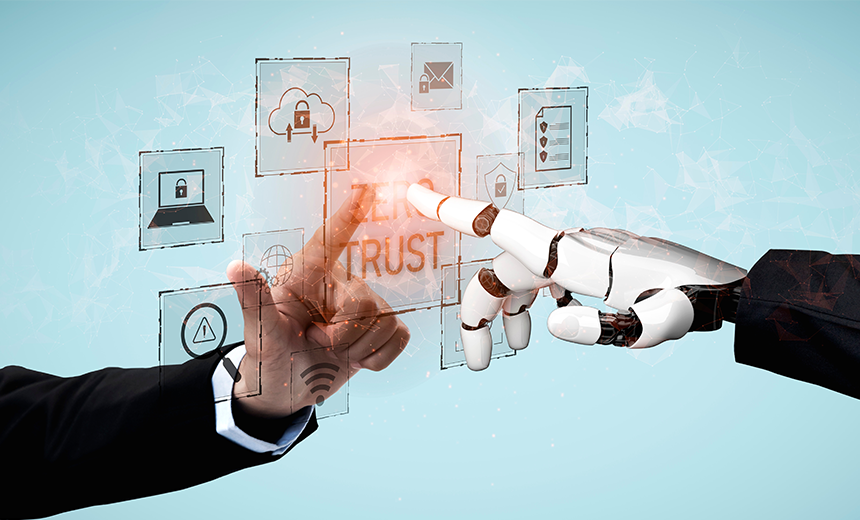
The foundations of enterprise security were built in an era when users sat inside office networks, applications lived in on-premise data centers, and machines followed predictable, centrally controlled workflows. Trust was largely implicit: once a user authenticated and crossed the perimeter, the internal environment was assumed to be safe. Firewalls, intrusion detection systems, and VPNs existed to keep attackers out, while internal traffic was rarely scrutinized with the same intensity.
That model has now collapsed.
Cloud computing erased physical boundaries. Remote and hybrid work dissolved location-based assumptions. Software-as-a-Service scattered critical data across dozens of external platforms. Artificial intelligence, combined with autonomous systems, has introduced non-human actors that authenticate, make decisions, move laterally, and execute actions at machine speed often without direct human oversight.
“Zero Trust is no longer a strategic option; it is a structural requirement,” said Rafay Baloch, CEO and Founder of REDSECLABS, a globally recognized cybersecurity expert and white-hat hacker specializing in security consulting and training. “When AI agents and automated systems operate continuously, static trust becomes a liability. Every identity, every request, and every action must be verified in real time, regardless of where it originates.”
In an environment where software thinks, decides, and acts, security can no longer be based on assumptions. Trust must be continuously earned, measured, and constrained. This is the context in which Zero Trust evolves from a framework into an operational doctrine for the age of intelligent systems.
The Collapse of the Perimeter
Traditional security architectures were designed around three assumptions: networks had clear boundaries, users were primarily human, and systems inside the perimeter were inherently safer than those outside. None of these assumptions hold in modern digital ecosystems.
AI-driven services communicate directly with cloud APIs, data lakes, identity platforms, and financial systems. Automation pipelines provision infrastructure, deploy code, and rotate credentials without human intervention. Service accounts and machine identities now outnumber human users by orders of magnitude. A single compromised token or poisoned model can traverse environments in seconds, far faster than any analyst or incident response team can react.
Baloch said this shift transforms cybersecurity from a network defense problem into a trust governance problem. “Location is no longer meaningful. Identity, behavior, and context are the only reliable control points in an environment where machines operate autonomously.”
Key Zero Trust Principles in the Age of AI
Why traditional perimeter security fails in AI-driven environments
Cloud platforms, SaaS applications, APIs, and autonomous agents operate beyond fixed network borders. Attackers no longer need to breach a firewall; they compromise credentials, tokens, automation scripts, or AI models. Once an internal identity is controlled, lateral movement can occur at machine speed, rendering perimeter-based trust obsolete.
Identity as the new security perimeter
Zero Trust replaces network location with identity as the primary security boundary. Every entity, human users, endpoints, workloads, containers, microservices, APIs, bots, and AI models is treated as an identity that must be authenticated, authorized, and continuously evaluated. Trust is never inherited from network position; it is derived from verified attributes and observed behavior.
Continuous verification instead of one-time authentication
Authentication is no longer a single event at login. Zero Trust continuously reassesses risk using context such as device posture, geolocation, access time, sensitivity of requested resources, and historical behavior. AI systems establish behavioral baselines and detect subtle deviations that may indicate account takeover, token theft, or automated abuse, triggering step-up verification or session termination.
Least privilege in dynamic, autonomous systems
Permissions are granular, task-specific, and time-bound. AI agents and automation workflows receive only the minimum access required for a particular operation, with privileges automatically revoked when the task is complete. Standing access and broad service roles are treated as systemic risk because they dramatically increase blast radius if compromised.
Micro-segmentation to contain lateral movement
Flat internal networks are replaced by fine-grained trust zones. Workloads are isolated, and every east-west connection is authenticated and authorized. AI-driven policy engines dynamically enforce segmentation based on risk, sensitivity, and behavior, preventing compromised agents or services from moving freely across environments.
Machine-to-machine trust management
Autonomous systems authenticate using certificate-based identities, short-lived tokens, hardware roots of trust, and mutual TLS. Static API keys and shared secrets are eliminated wherever possible. Every service-to-service call is treated as untrusted until verified, even when both services belong to the same organization.
Securing AI models as first-class identities
In Zero Trust, AI models are governed like privileged users. Their access to data, APIs, and decision authority is strictly scoped. Prompt injection, data poisoning, and model manipulation are treated as identity compromise events, requiring isolation, revocation, and forensic analysis.
Behavioral analytics for humans and machines
AI builds baselines for normal activity across users and systems, including access patterns, query behavior, transaction timing, and command sequences. Anomalies such as a finance automation querying HR records or an inference service attempting administrative actions are flagged and acted upon in real time.
Zero Trust for data in AI pipelines
Training data, feature stores, vector databases, and inference outputs are protected by classification, encryption, tokenization, and attribute-based access control. Models are authorized per dataset, per field, and per purpose. Blanket access is replaced by policy-driven, context-aware authorization.
Policy-driven automation with human oversight
Autonomous remediation actions, isolating workloads, revoking credentials, rotating secrets, or blocking transactions are governed by predefined risk thresholds. High-impact decisions require dual control or human-in-the-loop approval to prevent cascading failures.
Explainability and auditability of autonomous actions
Every access decision and automated response is logged, traceable, and explainable. Zero Trust demands visibility into why an AI system was permitted to act, what context influenced the decision, and how policy was applied.
Resilience against credential theft and token abuse
Short session lifetimes, continuous rotation of secrets, device binding, and behavioral re-authentication reduce the value of stolen credentials and limit their usability by automated attackers.
Integration with AI-driven security operations
Modern security operations centers use AI to correlate identity telemetry, network traffic, cloud logs, and behavioral data, enforcing Zero Trust policies in real time and orchestrating automated containment.
Governance of autonomous decision authority
As AI systems begin approving payments, modifying configurations, and triggering business workflows, Zero Trust enforces segmented authority, risk-based approval, and accountability. No system or machine has unconditional power.
Future-proofing against agentic AI
As models evolve into autonomous agents capable of planning and acting, Zero Trust becomes the framework that constrains scope, enforces accountability, and prevents intelligence from becoming implicit trust.
AI as Both Risk Multiplier and Security Enabler
Artificial intelligence dramatically increases the speed and scale of both attack and defense. A compromised agent can execute thousands of actions per second. A poisoned model can influence decisions across entire business processes. Machine identities can proliferate faster than traditional identity governance programs can track.
At the same time, AI is the only technology capable of enforcing Zero Trust at scale. It enables continuous authentication, behavioral baselining, real-time risk scoring, adaptive access control, and autonomous response. Without AI, Zero Trust becomes operationally unmanageable in complex, distributed environments.
Governing Autonomy with Trust Controls
Wyatt Mayham, Founder of Northwest AI Consulting, has repeatedly warned that autonomy without governance introduces invisible systemic risk.
“When decision-making becomes automated, the speed of both defense and failure accelerates,” Mayham said. “Zero Trust provides the policy framework that keeps autonomous systems accountable. Without it, organizations are simply accelerating trust assumptions rather than eliminating them.”
Mayham said every AI-driven action must be identity-bound, policy-constrained, auditable, and reversible. Intelligence, in other words, must never be allowed to bypass control.
Zero Trust Across the AI Lifecycle
Zero Trust must extend across the entire AI lifecycle:
Development:
Access to training data, model code, and experiment environments is restricted by role and purpose. Data poisoning risks are mitigated through provenance verification and integrity monitoring.
Deployment:
Inference services are isolated, authenticated, and authorized through mutual trust controls. Only approved systems can submit prompts or receive outputs.
Operation:
Model behavior is continuously monitored for drift, misuse, or anomalous access patterns. Runtime integrity checks detect tampering or unauthorized modification.
Decision and Action:
When models trigger downstream actions such as approving transactions, provisioning infrastructure, or responding to incidents, policy enforcement and human oversight ensure that autonomy operates within defined trust boundaries.
Compliance, Regulation, and Zero Trust
Regulators are increasingly focused on identity governance, data protection, and automated decision accountability. Zero Trust aligns naturally with these requirements by providing:
- Continuous access validation
- Least-privilege enforcement
- Comprehensive audit trails
- Explainable decision paths
- Segmented authority
- Data minimization and purpose limitation
As AI regulations mature, organizations that already operate under Zero Trust principles will be better positioned to demonstrate control, transparency, and compliance.
Zero Trust as an Operating Model
Zero Trust is evolving from a technical architecture into a trust operating system for digital enterprises. It governs:
- Human and machine identity
- Access and privilege
- Data flow and usage
- Automation scope
- Decision authority
- Accountability and audit
- Risk tolerance and response
Baloch said the future enterprise will be a mesh of human and machine actors operating continuously. “In that world, security is no longer about building walls. It is about continuously proving who or what deserves to act.”
Mayham added that the defining challenge of the next decade is not whether organizations will adopt AI, but whether they will adopt the trust models required to control it. “Autonomy without Zero Trust is acceleration without brakes.”
Conclusion
Artificial intelligence and autonomous systems have permanently transformed the cybersecurity landscape. Trust can no longer be implicit, static, or location-based. Every identity, every request, every decision, and every data interaction must be continuously verified, contextually evaluated, and strictly constrained.
Zero Trust provides the only framework capable of securing an environment where machines think, act, and decide. It replaces assumption with verification, standing privilege with dynamic control, and blind faith with measurable confidence.
In the age of intelligent systems, security is no longer about defending a perimeter. It is about governing trust itself.
