
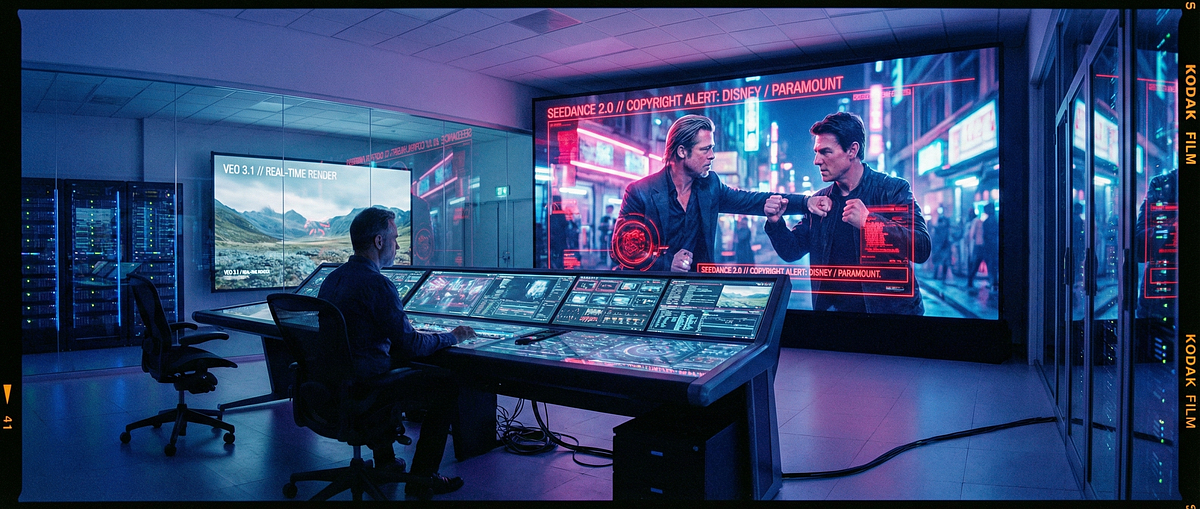
AI video generation in 2026 is no longer just about making short clips from prompts. That phase is already behind us. The real story now is how quickly the technology is becoming more usable, more controllable, and more relevant to real creative workflows.
A year ago, most discussions around AI video focused on visual novelty: could a model produce something cinematic, surreal, or technically impressive enough to go viral? In 2026, the expectations are much higher. Creators, marketers, developers, and product teams now want models that can do more than surprise them. They want systems that can follow direction, preserve consistency, support editing, and fit into actual production pipelines.
That shift is changing the market fast. AI video is moving away from one-off experiments and toward a more mature toolset built around reference-driven workflows, motion control, native audio, and API-based integration. The biggest developments of 2026 all point in the same direction: AI video is becoming less of a gimmick and more of a creative infrastructure layer.
AI Video Is Becoming Multimodal by Default
One of the clearest developments in 2026 is the move from silent video generation to fully multimodal output.
Earlier generations of AI video tools were mainly judged by how good the visuals looked. If the motion felt smooth and the imagery felt cinematic, that was often enough. But that standard no longer holds. Newer systems are increasingly expected to understand video as a combination of moving image, sound, timing, and atmosphere.
This matters because video is not just a visual medium. A polished result often depends on ambient sound, voice, effects, and rhythm just as much as on the frames themselves. As leading models move toward native audio generation, the workflow becomes much more streamlined. Instead of generating visuals in one tool, dialogue in another, and sound design somewhere else, creators can begin to work with models that treat video as a more complete audiovisual output.
That is a meaningful step forward. It brings AI-generated video closer to something that feels usable in marketing, storytelling, short-form content, and prototype production, rather than something that still needs multiple extra tools to feel finished.
Image-Led Workflows Are Now Central
Another major development is the growing importance of image-led video generation.
Text-to-video still matters, of course, and it remains one of the most attractive entry points for new users. But in real-world use, many of the most practical workflows now start from an image. That could be a keyframe, a storyboard panel, a product shot, a character portrait, or a campaign visual that needs animation.
Why Image-to-Video Matters More in 2026
For many creative teams, starting from text alone is simply too loose. It can produce interesting results, but it often struggles with visual consistency, brand alignment, or subject accuracy. When teams use an Image to Video API, they gain a much stronger foundation. The image provides a visual anchor, which makes it easier to preserve character identity, product shape, composition, lighting, and style.
This is especially important for commercial use. Brands rarely want “something cool.” They want something recognizable, on-brand, and adaptable across formats. A still image is often the best starting point for that.
From Still Frame to Moving Asset
As a result, image-to-video is becoming one of the most important building blocks in AI video generation. It supports workflows that are closer to actual creative production: take a visual concept, animate it, adjust motion, extend it, and repurpose it across channels.
That makes image-based generation less of a niche feature and more of a core capability. In many cases, it is the bridge between traditional creative assets and AI-native video workflows.
Control Is Replacing Randomness
Perhaps the most important change in 2026 is that control is becoming a top priority.
The first wave of AI video was exciting largely because it was unpredictable. You typed in a prompt, waited, and hoped the result would be strange, beautiful, or unexpectedly good. That kind of randomness still has value for ideation. But it is not what professional users want from a serious tool.
In 2026, the market is increasingly rewarding models that can follow direction.
Consistency Across Shots and Scenes
One major area of progress is consistency. Users want characters that stay recognizable across shots, objects that do not morph from frame to frame, and environments that remain stable as the scene evolves. This is essential for storytelling, ad production, branded content, and any workflow that extends beyond a single short clip.
Consistency is one of the hardest problems in AI video, and it is now one of the clearest markers of model maturity.
Motion and Camera Direction
Another key development is better motion control. Users increasingly expect to guide not just what appears in a scene, but how it moves. Camera motion, subject movement, pacing, and shot transitions are becoming part of the promptable or controllable layer.
That shift makes AI video feel less like a slot machine and more like a filmmaking tool. Instead of asking a model to “make something,” creators are starting to direct scenes with greater precision.
APIs Are Becoming the Real Distribution Layer
A major sign of maturity in 2026 is that AI video is no longer being defined only by consumer-facing web apps. Increasingly, the real action is happening at the API level.
That matters because the next stage of growth is not just about people visiting video generation websites. It is about developers embedding these capabilities inside other products: design tools, creative assistants, ecommerce platforms, ad builders, mobile apps, media workflows, and internal enterprise systems.
From Playground to Product Infrastructure
When a model is exposed through an API, it stops being only a demo experience. It becomes infrastructure. Teams can automate generation, build multi-step workflows, trigger video creation from user actions, combine it with editing tools, and create entirely new product experiences around it.
That is why terms like Image to Video API have become more important this year. They reflect a structural change in the market. Video generation is no longer just a destination. It is increasingly a feature inside broader software ecosystems.
Why Kling v3.0 API Matters
The same logic applies to the Kling v3.0 API. Its significance is not just that it gives access to a powerful model. It is that it represents the broader direction of the category: AI video tools are being packaged as flexible, developer-ready systems rather than isolated generation products.
For teams building creative products, automated ad workflows, AI content platforms, or video agents, that is a meaningful shift. What matters now is not just raw output quality, but whether a model can be integrated into repeatable workflows with enough control to be useful at scale.
Speed Tiers and Quality Tiers Are Separating
Another sign that the category is maturing is the growing distinction between fast-generation models and high-control models.
Not every use case needs the same thing. Sometimes a team needs rapid ideation and multiple variations in minutes. Other times, it needs higher visual fidelity, better scene stability, or more polished motion, even if that takes longer.
This separation is healthy for the market. It shows that users are becoming more sophisticated, and that vendors are designing models around actual workflow needs rather than trying to make one system serve every purpose equally well.
In practice, this means AI video stacks are becoming more layered. One model may be better for concept exploration, another for reference-based generation, another for extension or refinement, and another for audiovisual polish. That modular mindset is likely to define the next stage of the industry.
What This Means for Creators and Teams
All of these developments point to a larger conclusion: AI video generation in 2026 is becoming more useful because it is becoming more structured.
Creators benefit because they can move from rough ideas to more predictable outputs with less friction. Marketing teams benefit because they can animate brand assets more reliably. Product teams benefit because they can integrate video generation into apps and workflows through APIs rather than sending users to separate tools.
Most importantly, the conversation is becoming less abstract. The industry is moving beyond broad claims about “the future of creativity” and toward more concrete questions:
Can the model preserve identity and style?
Can it animate a reference image convincingly?
Can it support multi-shot workflows?
Can it generate results that are usable, not just interesting?
Can it be integrated into production software through API access?
Those are much more serious questions, and they reflect a much more serious market.
The Real Story of AI Video in 2026
The biggest development in AI video generation this year is not any single model launch. It is the overall change in what the category is trying to achieve.
AI video in 2026 is becoming more multimodal, more reference-driven, more controllable, and more programmable. Native audio is making outputs feel more complete. Image-based workflows are making creative direction more practical. Motion control is making results more usable. And APIs are turning video generation from a standalone novelty into a layer of modern software.
That is why mentions like Image to Video API and Kling v3.0 API matter in any serious discussion of the market this year. They point to the same underlying truth: AI video is no longer just about generating clips. It is about building repeatable, controllable, scalable video workflows that fit the way creative teams actually work. UtdPlug
And that is what makes 2026 feel like a real turning point.
