


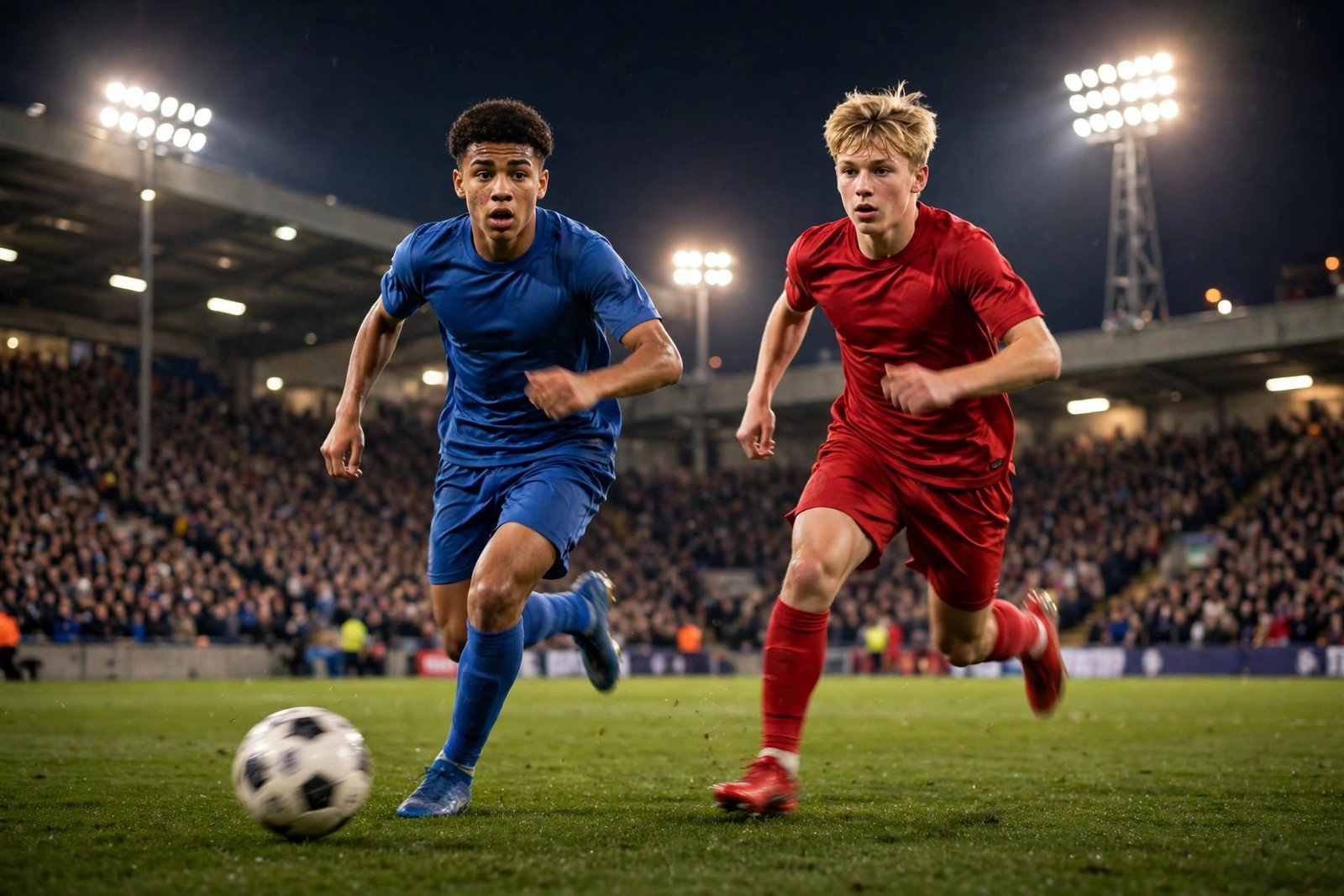
On 30 October 1937, Manchester United named Tom Manley and Jack Wassall in their side for an away match at Fulham. Nobody knew it at the time, but a record had just started that is still running today: every United matchday squad since that afternoon — more than 4,300 consecutive games, across nearly nine decades — has included at least one graduate of the club’s academy. No other club in world football has anything like it. This is how the record was discovered, what actually counts, and the players who have kept it alive.
How the Record Was Found
The strangest part of the story is that for most of its life, nobody at the club knew the streak existed. It was uncovered by Tony Park, a United supporter and historian, while researching his book Sons of United, published in 2013. Working through team sheets stretching back to the 1930s, Park realised the line was unbroken — back through the Ferguson era, the Busby era, the war years, all the way to that Fulham match in 1937. The club checked his work and adopted the record as official history. By November 2025 the count had reached 4,333 games; it has since climbed past 4,350 and into its 89th year. Records are usually made by players. This one was made by generations of them — and found by a fan with a spreadsheet.
What Counts as an Academy Graduate?
The definition matters, and United’s is stricter than the lazy version. A qualifying player must have signed for the club before turning 21, must not have played senior football for another club first, and must have played junior football at United. That is why the record is about the academy rather than about scouting: a teenage signing who arrives as a finished first-teamer does not keep the streak alive, while a boy who joins at nine and sits on the bench once does. More than 250 players have now appeared for United’s first team after coming through the academy — and the definition means every one of them, from Busby Babes to bench-fillers on wet League Cup nights, has carried the streak for exactly as long as they were needed.
The Names Who Kept It Alive
Read the record as a relay. The Busby Babes were not an exception to the system; they were the system — a team built almost entirely from the club’s own youth ranks, champions of England with an average age of 22. The 1968 European Cup side that completed the rebuild was anchored by graduates: Bobby Charlton, Bill Foulkes, Nobby Stiles, Shay Brennan. A generation later came the most famous academy class in football history — the Class of ’92, whose story we have told in full — Giggs, Scholes, Beckham, Butt and the Nevilles, the spine of the Treble team. In the modern era, Marcus Rashford carried the record as its most prominent face for years, a Wythenshawe boy scoring in a European final-winning squad; more recently the responsibility has passed to Kobbie Mainoo, whose emergence under successive managers — and whose future is debated in our piece on Kobbie Mainoo’s United future — has made him the streak’s current standard-bearer.
The Days It Nearly Ended
Records this long survive on luck as much as design. In November 2025, Mainoo — at that point the only academy graduate regularly in the squad — was injured shortly before a trip to Tottenham, and the streak survived only because 18-year-old Jack Fletcher was called up to the bench at short notice. Managers have repeatedly been briefed on the record when they arrive, and to their credit they have protected it even when it complicated selection: naming a youngster on the bench is easy, but naming the right one, in the right game, without it looking like a stunt, is the quiet skill the streak demands. The current crop pushing through — the five academy talents ready to break through at United — exist precisely so that the next near-miss has an answer ready.
How the Streak Works in the Modern Game
Sceptics make one fair point: with twenty-man matchday squads and nine substitutes, naming a graduate on a bench is easier in 2026 than it was when benches held two men and Busby named his boys in the first eleven. The honest answer is that the record has two layers. The squad layer — the official streak — now survives partly through squad depth. But the playing layer underneath it remains extraordinary by any era’s measure: graduates have not merely been present, they have started European finals, captained the club, broken its scoring records and won its player-of-the-year awards in every decade since the war. The streak’s critics count bench places. The streak’s defenders count the 1968 and 1999 finals, and note that on the biggest nights in the club’s history, the team sheet has always had Carrington’s fingerprints on it.
Why It Still Matters Under Carrick
It would be fair to ask whether the record is substance or sentiment. The substance is measurable: as recently as the 2020-21 season, United gave academy graduates more Premier League minutes than any other club in the country, and every one of the club’s trophy-winning sides — every single one — was built with graduates at its core. Under Michael Carrick, himself a man who captained the club and understands its codes, the pathway is being talked up again: teenagers training with the first team, debuts planned rather than stumbled into. The record’s real value is that it forces the question every single week, for every single manager: who is coming through? Eighty-nine years, 4,300-odd squads, one unbroken thread. The day it ends will be news. Until then, it is simply what Manchester United is.
